
Most people train martial arts like they’re collecting trading cards.
More techniques.
More combos.
More “styles.”
But real fighting skill isn’t built that way.

Skill is built by upgrading the operating system underneath the techniques: your base, your breath, your awareness, your timing, and your attention. These aren’t “style specific.” They’re human-specific. They show up in boxing, wrestling, BJJ, Muay Thai, karate, kung fu, and yes—internal arts like I Liq Chuan.

I Liq Chuan is often called “The Martial Art of Awareness,” and Grandmaster Sam Chin has spent decades refining a training method that makes these fundamentals measurable, repeatable, and pressure-testable. What I like about his approach is that it doesn’t rely on mythology. It relies on what you can actually do—under contact, under stress, against a resisting person.
Here are five concepts that will sharpen your fighting skills no matter what martial art you train in.
1. Balance: An Unstable Base Ruins Everything Upstream
All power comes from the ground.
That sounds cliché, but clichés often hide fundamental truths in plain sight.
If your base is unstable, you have to “borrow” stability from somewhere else—usually by holding our breath (more on this below), and muscling with our limbs. Fine if you’re 6′ 4″ and 250lbs, but you have to be born that way. That’s not something you can train.
When it comes to generating power in the martial arts, the goal is to learn to use our entire body in such a way that the “sum of the whole is greater than the sum of the parts.”

To an extent, this is the meaning of the so-called “internal power” so often discussed in the “internal” arts like Tai Chi, Xingyi, and Bagua. It comes from the coordination of mind, body, and breath that yields an “unusual power” that doesn’t seem like it should be possible for the person in question.
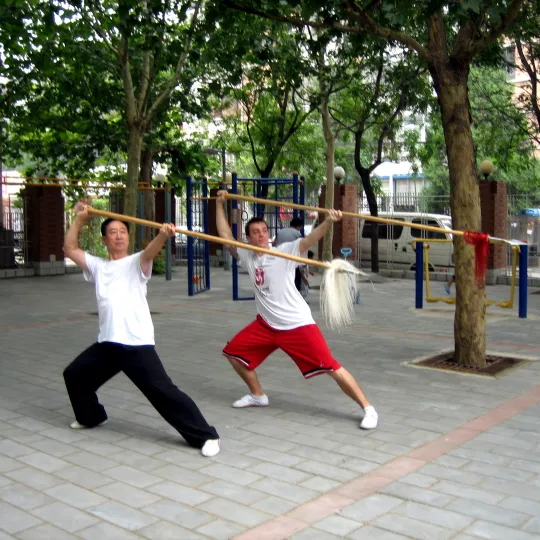

Balance isn’t standing still like a statue. Fighting balance is the ability to keep your structure functional while you move—while you change levels, and while you apply force. More importantly, it’s the ability to transition from one action to another smoothly, without gaps in your defense and without creating momentum that your opponent can exploit.
In I Liq Chuan training, we constantly test balance through contact: push, pull, strike, and kick. The goal isn’t “don’t move.” The goal is: can you stay organized and integrated while you move? Can you maintain a usable connection to the ground?
Real balance is being able to change—push to pull, pull to push, strike to kick, kick to strike, using your footwork to change angle and direction—without telegraphing, without wobbling, and without giving your opponent a handle on your momentum.
In other words, “balance” in martial arts isn’t a snapshot in time and space. It’s continuity.
If you want a simple takeaway: stop thinking of balance as “not falling.” Start thinking of balance as “the platform that lets you change direction and/or apply and redirect force on demand.” Fix your base, and suddenly your strikes feel heavier, your touch feels stickier, and your defense stops being pure panic.
2. Breathing: Don’t Let Your Movement Interfere With Your Breathing
GM Sam Chin often says, “Don’t let your movement interfere with your breathing.”
That one line is a diagnostic tool.
Most people think they breathe just fine… until they start moving hard. Then they hold their breath. Or they breathe high and fast in the chest. Their breath gets hijacked by tension.
And when your breath gets hijacked, everything gets worse:
- Endurance drops.
- Timing gets sloppy.
- Vision narrows.
- Technique degrades.
- Decision-making gets stupid.

Calm breathing isn’t just “spiritual.” It’s functional. It’s the difference between whole body power that comes from the big engines of the legs, hips, and core, or just the small muscles of the upper body. It’s the difference between staying present and going into survival mode.
Here’s a practical test: pick a simple movement—shadowboxing, footwork, pummeling, light sparring. Keep your breath smooth and flowing (i.e., coordinated with your movement). If your movement forces you to hold your breath, you’re exceeding your limits. Fix the movement until the breath stays smooth, uninterrupted, and coordinated with your action.
Pro Tip: “When in doubt, breathe out!“
I have written about many ways to use your breathing deliberately, which you can find here.
Unlock your full potential with our personalized in-person and remote coaching programs—join me and take the first step on your journey to mastery!
3. Awareness: You Can’t Correct What You Don’t Notice
Awareness is the foundation of improvement. GM Sam Chin says, “It is the ultimate technique.”
If you can’t feel what you’re doing, you can’t correct it.
If you can’t notice what your opponent is doing, you can’t adapt.
If you can’t detect pressure changes, you can’t adjust your structure.
If you can’t track your own tension, you can’t stop giving your opponent a handle.
This is why I Liq Chuan calls itself an art of awareness. Not just because “awareness is spiritual.” Because awareness is practical, it’s how your nervous system collects information and updates behavior in real time.

GM Sam Chin also says, “If you want to win the war, you must fight in the right battlefield.”
Meaning: if you’re fighting the wrong problem, you can train forever and still not improve.
Look For The Practical Before You Look For The Mystical
“One of the problems with the internal martial arts is that people are looking for an out-of-body experience before they’ve had an in-body experience. The real magic is found in refining the basics until my movement becomes a mystery to you.”
Awareness puts you on the right battlefield. It tells you what’s actually happening as it’s happening.
That’s not only philosophy. That’s actionable data.
4. Don’t Rush: Add Speed Only After Your Movement Is Right
I often tell students: Don’t train faster than your attention can keep up with.
Speed is seductive because it hides our movement errors and gaps. But speed without correctness is just rehearsing mistakes at a higher frame rate. You’re building a stronger version of your bad habits.
This is one of the biggest traps in martial arts: people equate intensity with progress. But intensity just amplifies whatever you already do. If your movement is bad, intensity makes it worse. If your posture collapses under mild pressure, intensity makes you fold faster.

In I Liq Chuan we use a progression that looks “slow” to outsiders—but it’s not slow for the sake of being slow. It’s slow so you can actually see and feel what’s happening. You’re training precision, alignment, timing, and sensitivity. Then you add pressure. Then you add speed.
The Four R Progression
In my classes, I like to use the four Rs:
- Remedial
- Rehearsed
- Reactive
- Resistance
That progression keeps you from rushing to the next step before you’ve built a stable foundation of smooth, efficient, effective action: first you fix the movement, then you sharpen timing, then you pressure-test it until it holds up. Which leads directly to the next piece—focus—because without trained attention, you can’t actually maintain the qualities you’ve developed.
Unlock your full potential with our personalized in-person and remote coaching programs—join me and take the first step on your journey to mastery!
5. Focus: The Mind Can Only Do One Thing At A Time
GM Sam Chin teaches, “The mind can only do one thing at a time.”
That’s not a motivational quote. That’s a training constraint.
Most people “train” while their mind is everywhere:
- Thinking about the next move.
- Thinking about what they should have done.
- Thinking about winning the round.

To put this into even sharper relief, GM Sam Chin says,
“You cannot do the two. The mind will be jumping back and forth (like multitasking). You must do the one to do the two. You pay attention to the right hand, you forget the left. You pay attention to the left hand, you forget the right. You pay attention to both hands, and you forget the feet. You must hold on to one point; only from one can you do two.”
You can only place attention on one thing at a time—and whatever falls outside of attention moves blindly. GM Sam Chin clarifies why this is not a coordination problem, but an awareness problem.
When attention jumps between hands (for ex.), one side drops out of monitoring and cannot adjust to the opponent’s actions, collapsing your defensive shield. Learn how referencing movement from a single point keeps both sides within awareness and preserves “fullness energy” under pressure.
(BTW, if you want to know the “secret” of what “the one” is, you’ll have to come train with me in Arizona, online, or invite me for a workshop in your area).
That scattered attention turns training into noise.
Awareness turns drills from “just reps” into high-level skills.
Let’s say you’re hitting the pads; most people focus on hitting the pads and getting their hand back into a defensive position as fast as possible.
These are important, no doubt, but what about all the space in between?
Were you there? Did you know? Was the point complete?
As GM Sam Chin says, “A circle is made up of one line, but the line is made up of all the dots. Each point itself is complete.”
The next time you’re hitting the pads, watch yourself closely. Is your attention cast outside yourself, on your target?
Can you see your attention jumping back and forth between hitting the pads (offense) and covering up (defense)?
Try keeping your attention inward on yourself only.
Anyone can learn to throw a decent punch or land a good kick, but only the masters can do it with qualities like fullness or the balance of six directions.
Only the best can merge offense and defense as one.
Awareness, or attention, is the key that unlocks this potential.
It’s worth reiterating here that you can’t fix what you don’t notice.
Coach Craig Glassman, of CrossFit fame, coined the phrase “virtuosity,” or doing the common uncommonly well.
Only when mind and body are one can you hope to achieve a level of mastery that turns your movement into a mystery to your opponent, that leaves them reeling and thinking to themselves:
“I don’t know where that power came from.
I don’t know why I feel so off balance.
I don’t know why I can’t find my rhythm, and why they seem to know my every move before I make it.”
As GM Chin says eloquently, “You can’t be faster than me if I’m already there.”
When your attention is strong enough, you can hold it in the moment. Then you will already be there.
What Is The Difference Between Attention & Focus?
Roughly speaking, we can say that attention, or awareness, is keeping your mind in the present moment, attending to what is happening now. In a martial arts context, we can talk about three faults that make it clearer:
- Hesitation
- Anticipation
- Resisting
Anticipation
Jumping ahead into the future—responding to what you think they’ll do.
You preload the counter.
You chase the setup that isn’t there yet.
You stop seeing what’s real.
Resistance
Trying to stay in the past, where you felt strong or safe.
You brace.
You lock.
You cling to a structure that used to work.
But the opponent already changed, so you’re fighting yesterday’s problem.
Hesitation
Also staying in the past—replaying what just happened instead of acting now.
You feel the opening… then double-check it.
You wait for confirmation.
The moment passes, and “late” becomes “never.”
When we don’t anticipate, resist, or hesitate, we call this “flowing.”
Focus, or concentration, is narrowing down our attention to a single point. We focus on one thing, and one thing only.
You could say that focus is narrowing down, attention is opening up. The key is focusing on the right “one thing” that allows us to expand our network of information and develop a wider “radar,” as GM Chin puts it. “Your future is in my present,” as he says.
In his book, I Liq Chuan – The Martial Art of Awareness (aka “The Yellow Book), GM Chin uses the analogy of a cleaver: focus is the thick back of the blade that gives weight to the sharp edge of awareness to allow it to cut to the depth that you see things as they are, as it is happening now.
Unlock your full potential with our personalized in-person and remote coaching programs—join me and take the first step on your journey to mastery!
Putting It Together: Fundamentals Beat Style Wars
“I don’t fear the man who has trained 10,000 kicks. I fear the man who has trained one kick 10,000 times.”
~Bruce Lee
No matter what art you train, these five concepts will improve your power, balance, and timing.
None of this is glamorous. None of it sells belts (it often doesn’t even look like martial arts). But it works.
And if you want a weekly training challenge, make it simple:
Pick one concept for one week and make it the theme of your training. Track it. Slowly test it under pressure.
Don’t chase novelty for its own sake. Chase clarity.
Real fighting skill isn’t built simply by knowing more techniques or more styles.

Read More!
- You Should Be As Strong As Possible For Self-Defense (& Daily Life)

- Warrior’s Diet: The Omega-3 Hack That Makes You Nearly Invincible in the Cold

- Five Concepts To Help Build Real Fighting Skill (No Matter What Martial Art You Train)

- Testosterone & Prostate Health

About the Author

Ashe Higgs, I Liq Chuan Master Instructor & L2 Nutrition Coach
Ashe is a highly skilled martial arts instructor and certified nutrition coach with over two decades of experience in the field. He holds a Master Instructor certification in I Liq Chuan under Sam FS Chin, making him one of only several individuals worldwide to hold the title. He has taught classes and workshops worldwide and is passionate about helping others achieve their fitness and wellness goals.
With a background in full-contact fighting and a Level 2 certification from Precision Nutrition in nutrition coaching, Ashe is a well-rounded expert in the fields of martial arts. In addition to his expertise, he has a wealth of experience in teaching and mentoring others. He has a natural ability to connect with his students and inspire them to reach their full potential.
Disclaimers & Conflicts of Interest
I am not a doctor or a lawyer, and the information provided should not be considered medical or legal advice.
The information provided is for educational and informational purposes only and should not be used as a substitute for professional legal or medical advice, diagnosis, or treatment. Consult your doctor or a qualified healthcare professional before making any changes to your diet, exercise routine, or lifestyle.
Please note that some of the links provided in this content may be affiliate links, meaning that I may receive a small commission if you purchase through them. However, please rest assured that any products or services recommended are based on my personal experience and belief in their value. I only recommend products or services that I have personally used and believe in.