Posted on

Choose Tradition Over Tech

Bryan Johnson, Biohacking & Threat of Transhumanism

In this week’s article, I’ll start by acknowledging that I am a bad person.

My better human nature knows I shouldn’t celebrate another person’s suffering.

Nevertheless, I have to admit to experiencing a certain amount of schadenfreude when I learned that Mr. “Don’t Die” himself, health influencer Bryan Johnson, recently announced on X that he has been diagnosed with autoimmune gastritis, or AIG.

In Johnson’s own colorful description:

“My stomach is eating itself.”

AIG is a chronic autoimmune condition in which the immune system attacks the cells in the lining of the stomach. These cells produce stomach acid and intrinsic factor, a protein required to absorb vitamin B12. As the damage progresses, AIG can interfere with iron and B12 absorption and eventually contribute to pernicious anemia and other complications.

Who’da thunk that avoiding the sun, meat, and chugging artificial supplements by the fistful would wreck your gut?

The irony is a little hard to ignore.

Especially because I had already planned to write about Johnson this week before the news dropped, but for a different reason.

I have been critical of him in the past. To my eye, he looks more like a prisoner of war than the “healthiest human alive.”

His diagnosis may not prove causation, but it certainly does not inspire confidence in the experiment, particularly when we consider the many, many, many current or former vegans all suffering from some sort of nutrient deficiencies and/or chronic gut issues. (Yes, folks, plants do, in fact, contain many mildly toxic compounds to deter predators; combined with disruptions in our gut microbiomes from exposure to antibiotics and Roundup, people have become increasingly sensitive to fiber).

Without exception, every vegan I have ever met was pasty, gray, and frail; always tired, sick, or injured, and more than a little unbalanced.

Before I start sounding like sour grapes, let me be clear: I don’t resent Johnson’s success. More power to him. I would love to reach as many people with my message as he does. Johnson is simply better at that than I am.

My beef with Johnson (and those like him, like Silicon Valley biohacker bros like Dave Asprey) rests on five pillars:

  • Biohacking is bullshit
  • Vegan advocacy
  • Fragility rather than resilience
  • Transhumanism
  • Imago Dei

The Map Is Not the Territory

It should be no secret by now that I am a big fan of the Ancestral Model of health and performance.

In my opinion, the Paleolithic, before the die-off of big game, was humanity’s true Golden Age. Ask yourself, “Why did the Natives of North America, or the Polynesians, never advance beyond Stone Age technology?”

My answer is: “Because they didn’t need to.”

“Evolution turns the unavoidable into the necessary.”

Moises Velasquez-Manoff

The abundance of fish, game, and natural forage, and even periods of scarcity, meant those people had everything they needed, with a Stone Age level of technology, to live out the full human experience.

As a counterpoint, one might note that the “average life expectancy was 35,” but the “average” is driven mostly by high child mortality and a lack of critical care. If you made it to adulthood (and didn’t die in combat, admittedly, both big “ifs”), your odds of reaching 70 or 80 were about the same as they are today, and regardless, short of the asteroid I pray for daily, going back to a Stone Age existence is not realistic.

Given that, what does it mean for us today? It means that we should think from first principles.

What environmental conditions shaped our physiology?

What signals does the human body expect to receive from food, sunlight, movement, temperature, microbes, sleep, danger, relationships, and the natural world?

Science writer Moises Velasquez-Manoff summarized the principle in a line I have quoted for years:

“Evolution turns the unavoidable into the necessary.”

When something remained present in the environment for hundreds of thousands—or millions—of years, evolution didn’t merely help us tolerate it; our physiology often came to depend on it.

That is the ancestral perspective in a nutshell.

Biohacking Is Bullshit

While a superficial pass of “biohacking concepts” might seem to pass the sniff test when discussing the basic principles of ancestral health models, in reality, they are diametrically opposed.

Biohacking takes many of the basic premises of Ancestral Health, and twists (if not inverts) them.

The Ancestral Model says nature has rules, and our job is to understand them well enough to live in harmony with them (even in a modern context). I am not a Luddite fundamentally opposed to the appropriate use of technology; however, the technology (and, by extension, biohacking) has some severe limitations.

I have written previously about the fallacy of chasing individual biomarkers in my article on fitness trackers. The premise of the “quantified self” assumes that we know enough about how the human system (and all its interrelated sub-systems) actually works that we can optimize human function by tweaking individual markers, and in many cases the mainstream medical consensus about any given marker is just flat-out wrong anyway (vis-a-vis cholesterol).

Using Johnson as an example again, he assiduously avoids the sun “because skin cancer.” Despite their stance on sun exposure and skin cancer, dermatology’s own published peer-reviewed literature shows repeatedly that those who get the most sun exposure have the lowest rates of mortality.

Even if we subdivide into groups of skin cancer/no cancer, those within the cancer group who get the most sun still generally live longer than those who get the least.

Emerging research in biophysics, which seeks to understand the role of light and electromagnetism in biology, provides evidence that sun exposure may help us require less food (up to a point) by facilitating the flow of electrons throughout the body, improving our “energy efficiency.”

While some self-proclaimed biohackers embrace the sun because it increases our levels of testosterone or vitamin D, sun exposure is so much more than that, and the odds that we have even already identified all the beneficial wavelengths of solar energy and the precise dose are close to zero.

Vitamin D is a great example of an individual biomarker that becomes the tail wagging the dog.

If vitamin D is actually just a proxy for sun exposure, artificially raising your blood levels through supplementation without actually getting exposure wastes time and money, which is why the peer-reviewed literature on supplemental vitamin D is so mixed. The most important benefits don’t come from the vitamin D itself; they come from the sun. Get enough sun, and the biomarkers take care of themselves.

While there are some supplements and metrics I find useful (like resting heart rate, blood sugar) on a week-over-week basis, chasing individual biomarkers is a fool’s errand.

Wearables can provide useful information, but dependence on a device can weaken our sense of personal agency and our natural ability to sense what is happening inside our own bodies. A watch tells you that you slept well, so you ignore the fact that you feel like hammered dog shit. Or it gives you a lousy recovery score, so you decide you must be exhausted despite having actually slept just fine.

To paraphrase the great Robb Wolf, our best three metrics are still:

  • How do I look?
  • How do I feel?
  • How am I performing?

The Cultivation of Fragility

I recently listened to an episode of the Matt Walsh podcast, and he helped bring into sharp focus some of the thoughts I had been having about the so-called healthmaxxing trend: it’s doing precisely the opposite of its stated goal; rather than building robustness, it’s cultivating fragility.

Bryan Johnson figures prominently here, but he’s hardly alone.

A recent clip that made the rounds online was a discussion between Chris Williamson and Steven Bartlett on Diary of a CEO. Bartlett claimed that three glasses of wine wrecked his productivity for the next three days.

How far have we fallen from the days when men could drink all night, get into a bar fight, sleep for four hours, and still show up for work the next morning? The men of my grandfather’s day often worked their entire lives without ever taking a single sick day.

Those men weren’t “optimized,” and they certainly didn’t worry about trends like “healthmaxxing.” They got up in the morning, and they got shit done.

They were resilient. Compare that to Johnson, who cancels his whole life whenever he doesn’t sleep well.

Does that sound like resilience, or fragility?

What Is Health?

People have spent decades trying to define health comprehensively.

But I think there’s a simple definition: health is resiliency, reserve, or the ability to bounce back. Chris Masterjohn recently wrote a short piece titled “Your North Star” that I think largely mirrors my own perspective.

How much life do you have in your years? (A point we will return to at the end).

How much punishment can you absorb before you stop being useful? How much disruption can life throw at you before you can’t train, can’t think, can’t work, can’t take care of your family?

Another way to think about it is to compare different kinds of vehicles.

An electric car is incredibly efficient—right up until the lights go out. Then it’s just a very large, very expensive paperweight.

A diesel truck can keep working much longer under adverse conditions. One that’s been converted to run on a wood gasifier can keep running even after the fuel infrastructure has collapsed altogether.

If your health only exists under perfect conditions—perfect sleep, perfect meals, perfect supplements, perfect recovery, perfectly controlled stress—then you don’t have health.

You have dependence.

Real health isn’t about functioning only when every variable is optimized. It’s the ability to be useful under the widest possible range of conditions for as long as possible.

Vegan Advocacy

I’ll freely admit to becoming more conservative throughout my 30s and 40s; however, what I think people should do and what they must do are two completely different things, and fundamentally, my core libertarian values from my youth remain intact (albeit with some more nuance), so if somebody wants to wreck their health by pursuing a vegan diet, that’s their business.

However, the problem is that you very seldom meet a vegan who is not also an activist.

Activists gonna do activist shit, and much like the “broccoli has more protein per calorie than steak”, their activism is very frequently based on lies to justify what is ultimately a purely ideological position, and sooner or later, it becomes an argument about how everyone else should eat.

I’ve been alive long enough to see veganism go from being that weird fringe thing that only the occasional straight-edge skater and Marxist-inspired anti-establishment types were doing to becoming mainstream.

Once the advocacy reached a certain level of popular support, combined with corporate profit motives, it became a policy argument, and now it’s everybody’s problem.

Now meat is becoming stigmatized, taxed, restricted, or made artificially expensive in the name of health, climate, or planetary necessity, to the point that “credentialed experts” are making the case it’s perfectly ethical to genetically engineer the population to be allergic to meat vis-à-vis Alpha Gal, and that the resulting physcially smaller population would actually be a good thing because they would require less resources.

Dismantling the vegan dogma results in cries for more censorship because “misinformation.”

My concern is not that Johnson personally refuses to eat steak, but that the worldview he helps promote will mean that ordinary people lose access to one of the most nutrient-dense foods available and that a fundamental aspect of American culture is systematically dismantled, all while the wealthy and politically connected continue to buy whatever they please.

As we saw during COVID, and as we see every year when the elite gather in Davos, the rule is usually simple: Rules for thee, but not for me. They demand we eat ze bugz while they eat Wagyu and caviar.

Transhumanism Is An Existential Threat

I’m not aware that Johnson has ever identified himself specifically as a transhumanist, but if it walks like a duck and quacks like a duck, well, then it’s usually a duck.

Transhumanism, at its core, is the belief that human biology is not an endpoint but a platform—something to upgrade, optimize, and eventually transcend through technology. It frames the body as hardware and consciousness as software, both subject to human intervention.

While this may sound abstract or distant, the early stages are already here.

In the present day, nowhere is this better understood than through the trans debate, where advocates claim that biology is not fixed and can be modified through surgical and hormonal interventions to align with self-proclaimed identities.

Limiting the discussion strictly to hardware- continuous glucose monitors, cochlear implants, and even everyday wearables like Garmin devices or Apple Watches has begun to blur the line between organism and machine.

In their current form, these technologies can be useful. They democratize access to data that was once locked behind clinical walls. You can now see, in real time, how your blood sugar responds to a meal, how your sleep cycles fluctuate, or how your heart rate adapts to stress. But crucially, these tools do not remove agency. You can still choose to eat foods that spike your glucose. You can ignore the data. Free will remains intact. This mirrors the early days of the internet—an open frontier that democratized information and expanded free speech. Knowledge became widely accessible, gatekeepers were bypassed, and individuals had unprecedented autonomy in what they consumed and shared.

But that phase didn’t last.

Over time, the digital landscape consolidated. Information became fragmented behind paywalls, subscriptions, and algorithmic control. Access was no longer free; it was rented. Now extend that trajectory forward. What happens when the interface is no longer in your hand, but in your head? When every human being has a direct link to the cloud? Today, if you read a physical book, whatever you retain is yours. It lives in your mind, shaped by your interpretation and memory. But in a fully digitized cognitive ecosystem, what does ownership even mean? If information can be downloaded instantly, it can just as easily be revoked. Access becomes conditional. Memory becomes a service. We have already been warned that by 2030, we will “own nothing and be happy.”

The question is whether that extends beyond physical goods into the realm of experience itself. Imagine being told that access to your own memories—your wedding day, the birth of your child—requires a fee.

“Your access has expired. Please renew for $29.99 to revisit this moment for the next 24 hours.” At that point, identity is no longer intrinsic. It is licensed.

And what of silence? What of solitude? Will there still be such a thing as a quiet moment, or will even our inner landscape be monetized—ads playing not on screens, but directly within the mind? Beyond the tokenization and commodification of the entire human experience lies a deeper threat: the erosion of liberty and autonomy.

If your brain has access to the internet, then the internet, by definition, has access to your brain. Privacy ceases to exist at the most fundamental level. Thought itself becomes observable, trackable, and potentially regulated. What happens when a governing body—or any centralized authority—can monitor and intervene in your innermost thoughts? Would dissent even be possible? Or would it be flagged in real time:

“Sorry, comrade, you are engaging in prohibited thoughts against the state. These thoughts have been restricted. Your digital currency has been frozen for 30 days. A fine has been issued and automatically deducted from your Universal Basic Income.”

Compliance would no longer be a choice; it would be enforced at the biological level. And if this trajectory continues, intervention may begin before birth. Through gene editing, biochemical modulation, and pre-programmed developmental pathways, compliance could be engineered into the system itself (for the good of all, of course)—long before an individual has the capacity to question, much less consent to it.

Imago Dei, Or Zen Is Learning How To Die

Once health ceases to be a path of stewardship and instead becomes life’s highest purpose, the body simply becomes raw material, a resource to be exploited, and death itself becomes the enemy.

The ancient Stoics understood something we’ve largely forgotten: Memento mori, “Remember death.”

Not only because death is inevitable, but because remembering your mortality changes how you live. Every day becomes precious precisely because it is finite. Zen master Shunryu Suzuki said, “Treat every moment as your last. It is not preparation for something else.” Death is the horizon against which a meaningful life is lived.

After watching Johnson and others like him, I’ve come to believe that beneath all the biomarkers, supplements, MRIs, and optimization lies something much simpler: they are terrified of their own mortality.

Technology offers the false promise of fleeting hope that they can stop the sands of time from moving through the hourglass; a desperate escape pod from which they can eject themselves into an illusion of eternal safety from the ever-sinking Titanic of human life.

In an increasingly Godless, tech-driven secular world, transhumanism is inevitable.

If there is no transcendent reality (or responsibility) beyond the material world, then salvation itself must become material. We begin by extending lifespan through better medicine, better nutrition, and better technology. Then we talk about genetic engineering, artificial organs, brain-computer interfaces, and, eventually, preserving consciousness itself in digital form.

It stands in direct opposition to one of the oldest ideas in the Judeo-Christian tradition: imago Dei.

We Are Made In The Image of God

Imago Dei simply means “the image of God.” It is the belief that mankind possesses inherent dignity and perfection, as we are, because we were created by God in his image. That has profound implications for how we view our body and our lives.

My body is not my property; it is not a machine that I own absolutely, free to modify without limit in pursuit of perfection; rather, it is a gift entrusted to me. I am its steward, not its owner.

We train. We eat well. We sleep. We recover. We care for our bodies because faithful stewardship requires it. A soldier maintains his rifle. A craftsman sharpens his tools. A martial artist conditions his body, but none of those things exist for their own sake.

Faith (or wisdom at any rate) doesn’t eliminate the reality of death, but it does change our relationship with it.

“They’re doomed.”
“Yes… but a thing isn’t beautiful because it lasts.”

Transcend The Duality of Life & Death

Zen became fashionable among Silicon Valley types, in part because it seemed to offer spirituality without God. Meditation, mindfulness, breathing exercises—all stripped from their original context and repackaged as tools for increasing productivity.

Mindfulness became an essential item of every optimized TechBro morning routine; non-judgment a self-congratulatory “Sorry, not sorry” apology for every nihilistic, self-absorbed pursuit of materialism, indulgence, general asshole-ry, and effective altruism, where the ends justify any means (despite the ends never aligning with the stated goals).

The Old Master Suzuki Shōsan argued that the true purpose of Zen was learning how to die, to move beyond the false duality of life and death as opposites.

Transhumanism stands diametrically opposed to the wisdom of the Old Masters who sought to change the person who must face death from within, and is an enemy of human flourishing. For all their success, Johnson and those like him are essentially pulling up the ladder behind them.

Start your journey to mastery today!

Read More!

About the Author

Ashe Higgs, I Liq Chuan Master Instructor & L2 Nutrition Coach

Ashe is a highly skilled martial arts instructor and certified nutrition coach with over two decades of experience in the field. He holds a Master Instructor certification in I Liq Chuan under Sam FS Chin, making him one of only several individuals worldwide to hold the title. He has taught classes and workshops worldwide and is passionate about helping others achieve their fitness and wellness goals.

With a background in full-contact fighting and a Level 2 certification from Precision Nutrition in nutrition coaching, Ashe is a well-rounded expert in the fields of martial arts. In addition to his expertise, he has a wealth of experience in teaching and mentoring others. He has a natural ability to connect with his students and inspire them to reach their full potential.

Read more about Ashe here…

Disclaimers & Conflicts of Interest

I am not a doctor or a lawyer, and the information provided should not be considered medical or legal advice.

The information provided is for educational and informational purposes only and should not be used as a substitute for professional legal or medical advice, diagnosis, or treatment. Consult your doctor or a qualified healthcare professional before making any changes to your diet, exercise routine, or lifestyle.

Please note that some of the links provided in this content may be affiliate links, meaning that I may receive a small commission if you purchase through them. However, please rest assured that any products or services recommended are based on my personal experience and belief in their value. I only recommend products or services that I have personally used and believe in.

Posted on

The Case For Training Low-Percentage Martial Arts Techniques

There is a time and a place for training low-percentage techniques. Yes, you read that right. Low-percentage techniques.

This is where the “80/20 rule”—aka the law of diminishing returns—comes into play. Early on, the basic stuff accounts for most of your progress with relatively little effort, but the closer you get to your individual limit, the more time, energy, and complexity it takes to squeeze out ever smaller improvements.

Before we go any deeper, make sure you’ve read my article on the difference between learning a technique and developing technical proficiency here:

  • By high-percentage techniques, I mean the basic, bog-standard stuff that works reliably under pressure: jabs, crosses, hooks, overhands, arm drags, hip tosses, simple foot sweeps, and so on.
  • Low-percentage techniques are more conditional and complex—things like unarmed knife defenses or elaborate joint-locking flow drills that require several variables to line up just right. That does not mean they never work; it means they offer a poor return on training time until your fundamentals are already solid.

The fight data bears this out. A comprehensive analysis of UFC submission finishes from UFC 1 through UFC 294 found that the rear-naked choke—the most basic choke in the book—was the single most common submission, accounting for 32.7 percent of submission finishes.

The Limits of Progress

An asymptote is a line that a mathematical curve approaches infinitely closely but never actually touches.

Progress in nearly every human endeavor is asymptotic, and time and effort are inversely correlated with results. That means you improve toward a limit, but the closer you get to that limit, the harder each additional bit of progress becomes.

Everyone’s limit is different. Age, sex, body type, natural athleticism, training history, injuries, temperament, and God knows what else all influence where that ceiling might be.

As the graph shows, the blue line represents theoretical progress, while the wavy red line represents real-world progress. The red line rises unevenly because life is never perfect: we get sick, get divorced, get laid off, get transferred, get injured, or get blindsided by circumstances outside our control. Setbacks are inevitable, and sometimes they knock people off course long enough that they quit altogether.

Regardless, the general progression is the same.

A novice can make rapid progress with a relatively simple program. Almost anything works because everything is new. The beginner does not need more complexity. He needs more practice.

An intermediate trainee has already harvested the easy gains. Progress slows, and training has to become somewhat more deliberate. Weaknesses begin to matter. Timing, context, and variation become more important.

The advanced practitioner is approaching his individual limit. At that point, continued progress will always be found at the margins. Training becomes more complex because the low-hanging fruit has already been squeezed dry.


Unlock your full potential with our personalized in-person and remote coaching programs—join me and take the first step on your journey to mastery!


“Training is the process of looking into your weakness.”

~GRANDMASTER SAM FS CHIN

No Shortcuts on The Journey To Mastery

This is where low-percentage techniques and subtle methods begin to earn their place.

But not before you’ve squeezed all the juice you can get from the basic, high-percentage stuff.

This is also why the so-called “internal” martial arts were never really meant for beginners—at least not unless the system has a curriculum, like I Liq Chuan (depending on who you’re training with), capable of establishing solid fighting fundamentals concurrently with, or preferably before, pursuing the deeper and more esoteric uses of the body and mind.

The legends surrounding the origins of Taijiquan, Xingyiquan, and Baguazhang are full of missing years, secret teachers, wandering sages, and immortals handing out secret fighting methods in dreams.

That ambiguity is part of the culture. The British didn’t refer to the Chinese as “inscrutable Celestials” for nothing.

But the strongest historical evidence points in the same direction: the founders and earliest students of the “big three” internal styles already possessed solid, practical fighting skills. They had mastered other methods first, then developed—or learned from someone who had developed—the subtler training we now call internal.

They were not helpless beginners learning to move slowly in the park. They were experienced fighters refining the margins.

Even Shaolin training traditionally follows a progression from hard, external physical development toward increasingly subtle, internal work. First you build the machine. Then you learn to operate it more efficiently.

Trying to reverse that order is like teaching advanced race-car driving to someone who still struggles to work a manual transmission in a 1980 Ford Fiat. They don’t have either the physical capacity or basic skills to make the advanced stuff effective with an uncooperative opponent.


Unlock your full potential with our personalized in-person and remote coaching programs—join me and take the first step on your journey to mastery!


Fundamentals First

The magic you're looking for is found in the hard work you're avoiding.

If you stick with it long enough, there will definitely come a time when training all the cool-guy shit will become not just optional but mandatory; however, beginners—and most intermediate students—have no business spending the majority of their time on “high-level,” low-percentage techniques and methods.

They do not yet possess the structure, timing, distance, pressure tolerance, or technical proficiency necessary for those methods to work.

At best, it is a waste of training time.

At worst, it actively interferes with the development of the fundamentals they should have been practicing instead.

Advanced methods are advanced because they sit near the edge of what is possible. They are supplements to, not substitutes for, the basics.

Similar to creatine or protein powders, they can help us eke out the last few percent (or fractions of a percent) of our performance, as we trend upward towards an inevitable limit hidden in plain sight, just behind a glass ceiling; within sight, but forever out of reach.

Start your journey to mastery today!

Read More!

About the Author

Ashe Higgs, I Liq Chuan Master Instructor & L2 Nutrition Coach

Ashe is a highly skilled martial arts instructor and certified nutrition coach with over two decades of experience in the field. He holds a Master Instructor certification in I Liq Chuan under Sam FS Chin, making him one of only several individuals worldwide to hold the title. He has taught classes and workshops worldwide and is passionate about helping others achieve their fitness and wellness goals.

With a background in full-contact fighting and a Level 2 certification from Precision Nutrition in nutrition coaching, Ashe is a well-rounded expert in the fields of martial arts. In addition to his expertise, he has a wealth of experience in teaching and mentoring others. He has a natural ability to connect with his students and inspire them to reach their full potential.

Read more about Ashe here…

Disclaimers & Conflicts of Interest

I am not a doctor or a lawyer, and the information provided should not be considered medical or legal advice.

The information provided is for educational and informational purposes only and should not be used as a substitute for professional legal or medical advice, diagnosis, or treatment. Consult your doctor or a qualified healthcare professional before making any changes to your diet, exercise routine, or lifestyle.

Please note that some of the links provided in this content may be affiliate links, meaning that I may receive a small commission if you purchase through them. However, please rest assured that any products or services recommended are based on my personal experience and belief in their value. I only recommend products or services that I have personally used and believe in.
Posted on

What is a Kung Fu Master Called?

What Is the Proper Name for a Kung Fu Master?

In the world of martial arts, the question often arises: what is a kung fu master called? The most widely accepted term in traditional Chinese martial arts is “Sifu” (師父, shī fù). However, this term carries a deeper cultural and relational significance than the simple title of “master.”

Student serves tea to his kung fu master
A student perofrms the traditional Baishi (tea) ceremony with his Kung Fu master.

The Term Sifu: A Closer Look

What Does Sifu Mean?

In Mandarin Chinese, “Sifu” (师父, shī fù) translates to “expert teacher” or “master teacher,” but its meaning goes beyond the literal. The term implies a bond that is both instructional and familial. It combines “shī” (师), meaning master, expert, or teacher, and “fù” (父), meaning father, but the term in the context of traditional Chinese martial arts reflects a relationship akin to that of a mentor or guru, or even a paternal relationship.

Unlike Western concepts of a “coach” or “teacher,” a Sifu in martial arts not only imparts technical knowledge but also guides the student’s personal and moral development. The relationship is often likened to that of a parent and child, emphasizing respect, loyalty, and mutual commitment.

Sifu Is Not Just for Martial Arts

Outside the martial arts context, “Sifu” (師傅) is a versatile term of respect. This Sifu sounds the same, but the “spelling” is different (note the different character). It can be used to address anyone who demonstrates mastery of a particular craft or trade. For example:

  • A highly skilled chef may be called “Sifu” in a kitchen.
  • A seasoned taxi driver or gardener might also be addressed as “Sifu.”
  • Buddhist monks are often referred to as Sifu (師父) by their students

This broader usage underscores the reverence for skill, experience, and dedication across all professions in Chinese culture.

Laoshi: Another Term for Teacher

Another term commonly associated with teaching is “Laoshi” (老师, lǎo shī). While it also translates to “teacher,” “Laoshi” is a more general term and doesn’t carry the same familial or hierarchical implications as “Sifu.” In a classroom setting or for academic instructors, “Laoshi” is the preferred term.

In martial arts, however, “Sifu” is the more appropriate designation when referring to someone who has taken on the role of both teacher and mentor.

Why Sifu Is Not a Title

It’s a common misconception that “Sifu” is a title to be used universally. As my own Sifu says, “You are not the whole world’s Sifu.” The term denotes a relationship, not a rank or title. For instance:

  • A student may call their teacher “Sifu,” but outsiders should not address that teacher in the same way unless they share the same bond.
  • In the context of a martial arts school, only those formally accepted as students would use this term.

This nuanced understanding is critical in preserving the integrity and respect of traditional martial arts practices. (It should be noted, however, that in modern times, even in the martial arts community, the term is used fairly loosely.)

The Deeper Meaning of Sifu

The relationship between a Sifu and their student goes beyond physical training. It’s similar to the Hindu concept of a “guru” or the English idea of a “mentor.” A Sifu shapes not only the student’s martial arts skills but also their character, discipline, and values. This holistic approach is why many students remain loyal to their Sifu for life, even as they advance in their martial arts journey.

In my own case, I have been training with my Sifu for over 20 years. We have a deep bond that goes far beyond the mats, and I will be loyal to, and be able to learn more from my Sifu, Grandmaster Sam FS Chin for many years to come.

The Use of Grandmaster in I Liq Chuan

Within the system of I Liq Chuan, the term “Grandmaster” carries a specific and structured meaning. In our curriculum, concurrent ranks are established for both students and instructors, with clear milestones for advancement. After achieving Instructor Level 4, an individual may be recognized as a “Master.” This designation is not merely honorary but reflects a significant level of skill, understanding, and contribution to the art, much like the “Master of Sport” in Russian athletics or chess.

GM Sam Chin with Ashe Higgs
GM Sam Chin offers me corrections during a workshop in Arizona.

The title of Master of Sport in Russian athletics is a prestigious designation awarded for exceptional performance in a specific sport. It typically requires meeting rigorous, measurable standards, such as achieving specific times, distances, or scores in competition. The criteria vary by sport but are overseen by national governing bodies and are highly standardized. This title reflects physical excellence, dedication, and the ability to compete at a national or international level.

In chess, the titles of Master (often National Master) and Grandmaster are also performance-based but rely on different metrics. Chess titles are awarded by federations like FIDE based on achieving specific rating thresholds and performance norms in rated tournaments. Grandmaster is the highest title, requiring sustained excellence against high-level competition, while National Master is typically a lower, more accessible benchmark.

A “Grandmaster” in I Liq Chuan is a Master who has trained and coached their own students to achieve the Master level. This achievement highlights not only their personal expertise but also their ability to pass on the knowledge and guide others to mastery. Grandmaster Sam Chin, therefore, serves as the “Headmaster” within our system, embodying the highest level of responsibility and leadership.

It is important to note that the terms “Master” and “Grandmaster” in I Liq Chuan are used as titles within the specific framework of our martial art that are largely irrelevant outside the context of I Liq Chuan. They signify rank and accomplishment within this system, ensuring clarity and respect for the hierarchy and traditions.

Misusing the Term Sifu

In modern times, there’s a tendency to use “Sifu” as a title for anyone teaching martial arts. However, this dilutes its cultural and relational significance. Referring to someone as “Sifu” should be reserved for those with whom you share a personal student-teacher connection.

Moreover, the term should not be self-appointed. A true Sifu earns the title through their actions, skill, and the respect of their students.

Conclusion

So, what is a kung fu master called? While the answer is commonly “Sifu” (师傅, shī fù), it’s essential to understand the depth and significance of this term. Beyond its literal meaning, Sifu represents a relationship built on trust, respect, and lifelong learning. Whether in martial arts or other crafts, using this term appropriately honors its cultural roots and the mastery it signifies.

Start your journey to mastery today!

Read More!

About the Author

Ashe Higgs, I Liq Chuan Master Instructor & L2 Nutrition Coach

Ashe is a highly skilled martial arts instructor and certified nutrition coach with over two decades of experience in the field. He holds a Master Instructor certification in I Liq Chuan under Sam FS Chin, making him one of only several individuals worldwide to hold the title. He has taught classes and workshops worldwide and is passionate about helping others achieve their fitness and wellness goals.

With a background in full-contact fighting and a Level 2 certification from Precision Nutrition in nutrition coaching, Ashe is a well-rounded expert in the fields of martial arts. In addition to his expertise, he has a wealth of experience in teaching and mentoring others. He has a natural ability to connect with his students and inspire them to reach their full potential.

Read more about Ashe here…

Posted on

The Ultimate Guide To Focus Mitts & Thai Pads For Martial Arts

Looking to elevate your martial arts training? Focus mitts and pads are the key to enhancing your skills and improving your performance.

Or are they?

Training with mitts and pads is a widely accepted practice in martial arts, but is it truly the most effective way to hone your striking skills? 

red and black focus mitts

Critics argue that it can lead to bad habits, incorrect distancing, and wasted training time. Yet, despite these criticisms, many high-level coaches still incorporate mitt work into their routines. Could it be that there’s more to this training method than meets the eye?

What if the very criticisms of mitt work are also the keys to understanding its true value?

In this article, we will delve into the pros and cons of mitt work, addressing common concerns while highlighting how this training tool can complement other methods to create a well-rounded striking regimen. How can we reconcile these apparent contradictions, and what role should mitt work play in your martial arts training?

Looking for alternatives? We also explore other training methods like shadow boxing, heavy bag training, partner drills, and sparring.

Whether you’re a beginner or a seasoned martial artist, this article has something for everyone looking to improve their skills and elevate their training.

Key Takeaways:

Pros & Cons of Mitt Work:

  1. Incorrect Distancing:
    • Con: Can lead to incorrect distancing as practitioners aim in front of the pad instead of at a real opponent.
    • Counterpoint: Provides real-time feedback and tactile contact, which helps joints and mechanoreceptors adapt, allowing for better adjustment of combinations, distances, and angles against a moving target.
  2. Timing Issues:
    • Con: The timing can be off due to the need for the pad-holder to be in position before strikes are thrown, leading to artificial pauses in combos.
    • Counterpoint: Helps rough out distance and timing, which can then be refined in positional and technical sparring, providing a progression towards more realistic scenarios.
  3. Inconsistent Training:
    • Con: Different pad-holders may provide inconsistent force and movement, leading to varying training quality.
    • Counterpoint: Offers a safer, controlled environment for beginners to practice striking without the stress of getting hit, which can help build confidence and provide a consistent starting point.
  4. Limited Realism:
    • Con: Does not fully replicate the dynamics of a real fight, making it less effective for training real-life striking scenarios compared to partner drilling or sparring.
    • Counterpoint: Allows the practice of various combinations, distances, and angles in a structured manner, helping to build foundational skills that can be further developed through sparring and partner drills.
  5. Wasted Training Time:
    • Con: Requires a partner to hold pads, which can be seen as a waste of training time for both parties compared to other training methods like bag work or partner drilling.
    • Counterpoint: Provides a good cardiovascular workout, with the pad-holder able to set the pace to ensure a challenging session, benefiting overall fitness and endurance.
  6. Potential Bad Habits:
    • Con: Can develop bad habits like punching short of the actual target if the pad-holder moves the pad towards the striker.
    • Counterpoint: Reinforces basic striking mechanics, helping to maintain proper technique while working on endurance and coordination, which can counteract the development of bad habits when combined with other training methods.

Conclusion:

Mitt work, while not a substitute for partner drilling, is a complementary tool in a comprehensive training regimen. Addressing the cons with their respective counterpoints highlights the importance of incorporating mitt work alongside other training methods like solo technical work, bag work, positional sparring, and technical sparring.

Each method has its uses and limitations, and the goal is to employ the right tool at the right time in the right dose to create a well-rounded training program.

What Are Focus Mitts/Pads?

Focus mitts, also known as focus pads, are essential training tools used in various combat sports like Western boxing and MMA to help practitioners improve their punching techniques and overall skills.

These mitts are designed to be held by a training partner, allowing the practitioner to practice striking with precision and accuracy. Typically made of thick padding to absorb impact, they are shaped to provide realistic targets for punches and are held in a specific position to mimic opponent movements.

Focus mitts play a crucial role in training sessions as they not only help improve striking techniques but also enhance hand-eye coordination and timing. Various martial arts disciplines like Muay Thai, kickboxing, and mixed martial arts also incorporate focus mitts into their training regimens for developing speed and accuracy.

What Are the Benefits (& Drawbacks) of Using Focus Mitts/Pads for Martial Arts Training?

Bruce Lee, known for his philosophy of ‘be like water’, emphasized the importance of adapting to different situations in martial arts. By using focus mitts/pads, practitioners can hone their reflexes, timing, and accuracy, which are essential skills in combat scenarios. These training tools allow fighters to work on precision strikes, combinations, and defensive techniques in a controlled yet dynamic environment.

Distancing: The Challenge and the Counterpoint

Con: Incorrect Distancing One of the primary criticisms of mitt work is that it can lead to incorrect distancing. When striking pads, practitioners often aim in front of their partner rather than at an actual opponent. This practice can result in an inaccurate sense of range, as fighters become accustomed to throwing punches from a distance that wouldn’t be effective in a real fight. Additionally, pad-holders tend to move the pads towards the striker, which can train practitioners to punch just short of their actual target. This discrepancy can be particularly problematic, as it systematically develops habits that may not translate well to a live opponent.

Counterpoint: Real-Time Feedback and Adaptation Despite the potential for developing incorrect distancing, mitt work offers significant benefits in terms of real-time feedback and tactile contact.

This feedback is crucial for the adaptation of joints and mechanoreceptors, which play a vital role in striking accuracy and effectiveness. By practicing with pads, fighters can adjust their combinations, distances, and angles against a moving target, thereby enhancing their ability to react and adapt in dynamic situations. While mitt work might not perfectly replicate the exact distancing of a real fight, it provides a valuable tool for refining these skills in a controlled environment. Furthermore, the structured nature of mitt work allows practitioners to focus on specific aspects of their technique, such as footwork, timing, and coordination, which can subsequently be applied and adjusted in partner drills and sparring sessions. When used in conjunction with other training methods, mitt work can help fighters build a solid foundation in striking, which can then be fine-tuned in more realistic training scenarios.

Timing: The Drawback and the Solution

Con: Timing Issues

A significant drawback of mitt work is the potential for developing poor timing habits. During pad sessions, the striker often has to wait for the pad-holder to be in position before throwing the next strike in their combination. This results in artificial pauses that do not reflect the fluidity required in a real fight. Such interruptions can teach fighters to wait for their opponent to be ready, which is the opposite of how striking should function in a combat scenario.

Counterpoint: Roughing Out Timing for Refinement

While mitt work can lead to timing issues, it also serves as an essential step in the progression of developing accurate timing. By working on pads, practitioners can start to rough out their sense of timing in a structured and controlled environment. This preliminary stage is crucial for understanding the basic rhythm and pace of combinations. Once a basic sense of timing is established, it can then be refined in more advanced training methods, such as positional and technical sparring.

Additionally, mitt work helps fighters understand the coordination between strikes and movements, providing a framework for smoother transitions and faster combinations. The pad-holder’s role in setting the pace ensures that the striker maintains a consistent tempo, which can be gradually increased to improve speed and reaction times. This controlled pace allows fighters to build the foundational timing skills necessary for more spontaneous and reactive fighting scenarios.

In summary, while mitt work alone may not perfect a fighter’s timing, it lays the groundwork for more precise and effective striking. When combined with positional and technical sparring, where the fluidity and unpredictability of an actual fight are simulated, mitt work becomes an invaluable component of a comprehensive training regimen.

Inconsistent Training: The Challenge and the Context

Con: Inconsistent Training

One common criticism of mitt work is the inconsistency that arises from different pad-holders. Each pad-holder may apply varying amounts of force and movement, leading to a lack of uniformity in training.

This can result in mixed results for practitioners, as they may not receive the same quality of training each time they practice with a new partner. Such variability can hinder the development of consistent striking skills and create confusion about the proper execution of techniques.

female kickboxer kicks thai pads

Counterpoint: A Universal Challenge in Group Settings

Inconsistent training is not unique to mitt work; it is a reality in any partner-based training within a group setting. Whether it’s partner drilling, positional sparring, or technical sparring, variations in partners’ skill levels, physicality, and techniques are inevitable. This variability, while presenting challenges, also offers opportunities for adaptation and improvement. Training with different partners can expose fighters to a range of styles and responses, which is crucial for developing well-rounded skills.

Structured Environment and Skill Building

Despite the potential for inconsistency, mitt work provides a structured environment that is especially beneficial for beginners. It allows practitioners to practice striking without the stress of receiving hits, building confidence and foundational skills in a controlled setting. The pad-holder can adjust the intensity and pace to suit the striker’s level, ensuring a safer and more focused training session.

Moreover, mitt work can help bridge the gap between solo technical work and more interactive drills. It provides an intermediate step where fighters can focus on perfecting their techniques before applying them in more variable and dynamic partner drills. The consistency offered by a skilled pad-holder can help beginners develop a solid foundation, which can then be tested and refined through varied partner interactions in other training methods.

Using focus mitts in my Tempe martial arts classes

Adaptation and Real-World Application

Training with different partners in mitt work sessions can also simulate real-world scenarios where opponents vary widely. This exposure helps fighters learn to adapt their techniques and strategies, enhancing their ability to respond to different fighting styles and conditions. While inconsistency presents challenges, it also enriches the learning experience by preparing fighters for the unpredictability of actual combat.

In conclusion, while inconsistent training is a valid concern in mitt work, it is a common challenge across all partner-based training methods. The structured environment of mitt work, combined with the variability of different partners, offers a balanced approach to developing versatile and adaptable striking skills.

Limited Realism: The Drawback and the Balance

Con: Limited Realism

A notable criticism of mitt work is its limited realism. Pads do not fully replicate the dynamics of a real fight, as the strikes are aimed at artificial targets rather than a live opponent. The interaction with pads lacks the spontaneous movement and resistance of an actual adversary, which can limit the effectiveness of this training method in preparing fighters for real combat scenarios. As a result, practitioners might not develop the reactive and adaptive skills necessary for facing unpredictable opponents in a fight.

Counterpoint: An Intermediate Training Method

While mitt work may not entirely simulate the realism of a live opponent, it serves as a valuable intermediate step between solo bag work and sparring. Bag work, although useful for practicing power strikes, lacks the interactive and responsive elements of a human opponent. Heavy bags do not look like, move like, or react like humans, making them less realistic despite the ability to strike with full power without needing a partner.

Mitt work, on the other hand, provides a more interactive experience. It allows fighters to practice combinations, distance adjustments, and angles against a moving target, albeit not a fully realistic one. The pad-holder can simulate certain movements and offer dynamic feedback that a bag cannot, bridging the gap between the isolation of bag work and the complexities of sparring. This interactivity helps fighters develop better coordination, timing, and precision in their strikes.

Building Realistic Skills Gradually

Using mitt work as an intermediate step helps fighters build foundational skills in a controlled environment before transitioning to the more unpredictable nature of sparring. The structured nature of mitt work allows for focused practice on specific techniques and combinations, which can then be tested and refined in sparring sessions. This gradual progression is essential for developing effective striking skills without overwhelming beginners with the full intensity of live sparring too soon.

Balancing Training Methods

Mitt work also allows for a more balanced approach to training. While it may not offer the full realism of sparring, it compensates by providing a safer and more manageable environment for practicing complex techniques. The variability and feedback from a pad-holder help fighters adjust their strategies and improve their accuracy, preparing them for the next level of training.

In summary, while mitt work may have limitations in terms of realism, it plays a crucial role in the overall training hierarchy. It serves as a necessary bridge between solo bag work, which focuses on power and endurance, and sparring, which introduces the unpredictability and dynamics of a real fight. By incorporating mitt work into a well-rounded training regimen, fighters can develop their skills progressively, ensuring a solid foundation before moving on to more advanced and realistic training methods.

Can Be Expensive

High-quality focus mitts/pads, such as those from Fairtex, can be quite expensive, which might be a deterrent for some gym-goers.

When considering the investment in quality focus mitts/pads, one must also take into account the durability and performance benefits that come with reputable brands like Fairtex. While the initial cost may seem steep, the long-term value they provide can outweigh the price tag. Choosing to purchase from well-known brands ensure the product’s quality and build, reducing the likelihood of needing frequent replacements, ultimately saving money in the long run.

Requires a Partner

Using focus mitts/pads requires a partner, which can be a limitation for those who prefer solo training or lack a training partner to practice their skills.

Having a partner for focus mitt training is crucial as it simulates real combat scenarios, improves timing, accuracy, and hand-eye coordination. Partner work allows for dynamic drills that enhance reflexes and responsiveness. The reliance on a partner can pose challenges for individuals who have scheduling conflicts or limited access to training companions. While some may thrive on the energy and motivation derived from partner drills, others may find their progress hindered due to partner availability constraints.

How to Properly Use Focus Mitts/Pads for Martial Arts Training?

To properly use focus mitts/pads for martial arts training, it is essential to follow certain guidelines and ensure the use of appropriate boxing gloves to develop correct technique.

Choose the Right Size and Type of Mitts/Pads

Choosing the right size and type of mitts/pads, such as Muay Thai pads, is crucial for effective training and injury prevention.

In terms of engaging in combat sports like boxing or Muay Thai, having the proper equipment can make all the difference in your performance. Selecting the appropriate size and type of mitts or pads can directly impact the intensity of your training sessions and the longevity of your joints and muscles. With Muay Thai pads specifically, their design allows for a more versatile training experience, enabling practitioners to work on their striking techniques with enhanced precision and power.

Communicate with Your Partner

Effective communication with your training partner is essential when using focus mitts/pads to ensure safety and maximize the benefits of your training session.

Clear communication between you and your partner helps in coordinating movements, adjusting the intensity of strikes, and providing real-time feedback. Remember to establish signals or cues to indicate changes in speed or power levels, ensuring a smooth and effective workout. Communication also builds trust and strengthens the bond between partners, creating a supportive environment for growth and skill development.

Focus on Technique and Accuracy

Focusing on technique and accuracy while using focus mitts/pads helps in the development of precise skills required for martial arts.

Proper technique ensures that strikes are executed efficiently, reducing the risk of injury and maximizing power. It also enhances muscle memory, making movements sharper and more effective.

Accuracy, on the other hand, is crucial for honing timing and precision. By hitting the mitts/pads with precision, practitioners learn to control their movements and hit specific targets consistently.

Mastering these skills through focused training sessions not only improves performance but also builds confidence and discipline in martial artists.

Use Proper Striking Techniques

Using proper striking techniques when training with focus mitts/pads is essential to prevent injury and enhance the effectiveness of your workouts.

One fundamental aspect to keep in mind during your striking techniques is maintaining a strong, stable stance to generate power and control. This involves distributing your weight evenly, keeping your knees slightly bent, and pivoting your hips with each strike.

Focusing on proper hand positioning is crucial for protecting your joints and maximizing impact. Ensure your fists are clenched tightly without straining your wrists, and aim to make contact with the center of the mitt or pad to optimize the transfer of force.

What Are Some Alternatives to Using Focus Mitts/Pads for Martial Arts Training?

There are several alternatives to using focus mitts/pads for martial arts training, each offering unique exercises and benefits to complement your training regime.

Shadow Boxing

Shadow boxing is a great alternative to focus mitts/pads, allowing martial artists to practice their skills and techniques without any equipment.

One of the key benefits of incorporating shadow boxing into training routines is the freedom it offers in movement and technique execution. Unlike focus mitts/pads, which require a partner and specific equipment, shadow boxing can be done solo and anywhere, making it a versatile and accessible training method.

Shadow boxing helps in developing muscle memory, improving footwork, enhancing speed and accuracy, and honing overall fighting skills. It allows fighters to visualize opponents, practice combinations, and work on defensive maneuvers, thereby contributing to skill refinement and technique mastery.

Heavy Bag Training

Heavy bag training is an effective alternative to focus mitts/pads, providing a solid target to build power and endurance in a gym environment.

One of the key benefits of incorporating heavy bag training into your workout routine is the enhanced power development it offers. The constant resistance provided by the weight of the bag helps to increase strength and explosiveness in punches and kicks. This type of training also improves overall endurance, stamina, and cardiovascular health.

In addition, heavy bag training is highly versatile and suitable for individuals of all fitness levels. Whether you are a beginner looking to improve technique or a seasoned athlete aiming to enhance power, the heavy bag can adapt to your training needs. Plus, hitting a heavy bag can be a great way to release stress and boost mental clarity during your gym sessions.

Partner Drills

Partner drills offer a dynamic alternative to focus mitts/pads, enhancing training by allowing practitioners to develop their skills through interactive exercises.

One type of partner drill commonly used in martial arts is the ‘mirror drill,’ where two partners mirror each other’s movements to improve technique and coordination. Similarly, ‘reaction drills’ focus on quick reflexes and timing, with one partner initiating a movement to which the other must react swiftly. Another effective partner drill is the ‘obstacle course,’ which challenges agility and footwork as partners navigate around obstacles set up in their training space.

For advanced practitioners, ‘altered target drills’ can be incredibly beneficial, where partners switch up targets spontaneously, requiring adaptability and precision. ‘Controlled sparring drills’ provide a simulated combat experience, allowing practitioners to apply their techniques in a more dynamic and unpredictable setting.

Sparring

Sparring is an essential component of training in disciplines like MMA and Muay Thai, providing a realistic and immersive alternative to focus mitts/pads.

Engaging in sparring sessions allows practitioners to apply their techniques in a dynamic and unpredictable setting, simulating real combat scenarios. This form of training not only enhances physical conditioning and technique but also fosters mental fortitude and adaptability. It teaches students to think on their feet, strategize, and react swiftly to their opponent’s moves. By experiencing varying styles and intensities during sparring, martial artists develop a deeper understanding of timing, distance, and defense mechanisms, which are crucial in actual competitive bouts.

Summary and Conclusion

Training with mitts and pads has its share of criticisms, often seen as an inefficient use of training time that could be better spent on partner drills or sparring. However, it’s important to acknowledge that a tool is only as good as the craftsman who uses it. When used effectively, mitt work can significantly enhance a fighter’s skills.

All Training Methods Are Approximations

All training methods, including sparring, are merely approximations of actual fighting. Each serves to model different aspects of combat, helping fighters develop a comprehensive set of skills. Mitt work provides a controlled environment for focusing on specific techniques, speed, accuracy, and coordination—elements that are harder to isolate in the unpredictable nature of sparring.

Mitt Work as a Supplement

Mitt work should be viewed as a supplement rather than a substitute for sparring. It bridges the gap between solo bag work, which focuses on power and endurance, and sparring, which introduces the dynamics and unpredictability of a real fight. Mitt sessions offer the opportunity for repetitive practice and immediate feedback, crucial for refining techniques that can then be tested and adjusted in more realistic settings.

Finding the Right Balance

The key to effective training lies in integrating mitt work into a comprehensive regimen that includes solo technical work, bag work, partner drills, and sparring. Each method has its place and unique benefits, and the right balance ensures that all aspects of a fighter’s skills are developed.

In conclusion, while mitt work has its limitations, it remains a valuable component of martial arts training. By understanding its role and incorporating it appropriately, fighters can build a solid foundation, refine their techniques, and become more versatile and effective in the ring. It’s all about using the right tool at the right time, in the right dose, to achieve the best possible results in martial arts training.

Frequently Asked Questions

Where To Buy Boxing Focus Mitts?

What are the benefits of using focus mitts/pads for martial arts training?

Using focus mitts/pads can enhance hand-eye coordination, speed, and accuracy. It also allows for full range of motion and power in strikes, providing a more realistic training experience.

Are there any downsides to incorporating focus mitts/pads into martial arts training?

One potential downside is the cost of purchasing focus mitts/pads. They can also be bulky and difficult to transport, making it challenging to train outside of a designated gym or studio.

How can using focus mitts/pads improve my martial arts technique?

Focus mitts/pads provide a moving target and require the practitioner to adapt and adjust their strikes accordingly. This can improve footwork, timing, and overall technique.

What should I look for when purchasing focus mitts/pads?

When purchasing focus mitts/pads, consider the material, size, and durability. It’s important to choose mitts/pads that can withstand the impact of strikes and provide adequate protection for the holder.

Can focus mitts/pads be used for all types of martial arts training?

Yes, focus mitts/pads can be used for a variety of martial arts styles, including striking arts like Muay Thai and Karate, as well as grappling arts like Brazilian Jiu-Jitsu and Judo.

Is using focus mitts/pads a suitable alternative to sparring for practicing martial arts techniques?

While focus mitts/pads can be a useful training tool, it should not be used as a replacement for sparring. Sparring allows for more realistic and dynamic training, while focus mitts/pads can provide a controlled and repetitive experience

Start your journey to mastery today!

Read More!

Disclaimers & Conflicts of Interest

I am not a doctor or a lawyer, and the information provided should not be considered medical or legal advice.

The information provided is for educational and informational purposes only and should not be used as a substitute for professional legal or medical advice, diagnosis, or treatment. Consult your doctor or a qualified healthcare professional before making any changes to your diet, exercise routine, or lifestyle.

Please note that some of the links provided in this content may be affiliate links, meaning that I may receive a small commission if you purchase through them. However, please rest assured that any products or services recommended are based on my personal experience and belief in their value. I only recommend products or services that I have personally used and believe in.

Posted on

Kung Fu vs Boxing

In the age-old debate of Kung Fu vs Boxing, a question often arises: why does Western boxing seem to overshadow the combat effectiveness of most traditional Eastern martial arts?

This inquiry delves into a realm where the clash of cultures and fighting philosophies is as striking as the physical confrontations themselves.

While the grace and discipline of Eastern martial arts are revered, it’s an open secret that many of these traditional styles may not fully prepare a student for the raw unpredictability of real combat.

The reasons for the effectiveness of Western boxing are as multifaceted as the sport itself. It begins in the boxing gym, a crucible where frequent sparring is not just a practice but a rite of passage, honing a boxer’s sense of timing and distance against a live, resisting opponent.

Then there’s the arena of competition, a stage where skills are not only showcased but also rigorously tested under the pressure of non-compliance, refining techniques, and weeding out inefficiencies.

Over time, the intensity of training at a boxing gym serves as a de facto selection process, akin to the special forces, ensuring that only the most resilient and skilled fighters rise to prominence, leaving no room for mediocrity.

Yet, amidst this exploration, one might wonder: are there exceptions within the vast landscape of Asian martial arts? Could there be traditional styles that marry the philosophical depth of the East with the practical combat readiness of the West?

This article embarks on a journey to unravel these questions, weaving through the diaspora of martial arts to uncover the truths and myths behind their effectiveness.

Join us as we delve into a world where tradition meets practicality and where the lines between Eastern and Western martial arts are both defined and blurred.

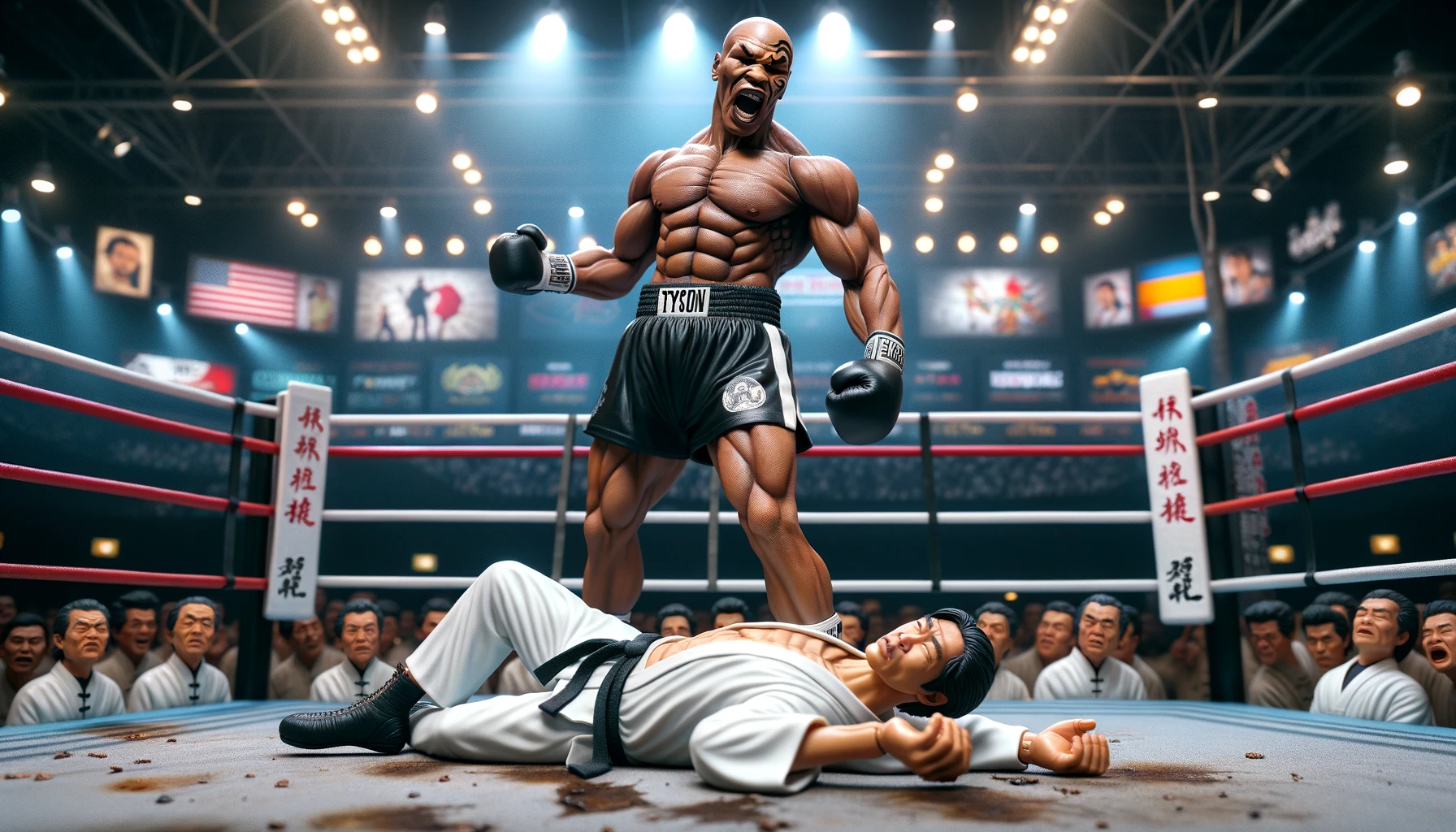
Kung Fu vs. Boxing – Mike Tyson fights Donnie Yen in Yipman.

Kung Fu vs Boxing’s Partner Training Approach

In the heart of a bustling boxing gym, where grunts of exertion and the rhythmic crack of gloves against the mitts forms a relentless beat, lies the essence of a boxer’s skill: frequent, regular sparring. This is where the poetry of The Sweet Science transcends its physical form, transforming into an art that is both brutal and beautiful.

Imagine stepping into the ring, the canvas underfoot resonating with the echoes of countless battles fought before. The air is electric, charged with adrenaline and the sharp tang of sweat. Across from you stands your sparring partner, not just an opponent but a mirror, reflecting every strength and exposing every weakness.

In these sparring sessions, boxers learn the subtle art of reading their opponent. It’s a high-stakes game of chess played at lightning speed. Every feint, every jab, and every cross is a word in a silent conversation, a dialogue of fists and footwork. Here, timing is not just a skill; it’s a survival instinct. The right move at the right moment can mean the difference between a knockout and being knocked out.


“Battle is the Great Redeemer. It is the fiery crucible in which the only true heroes are forged. The one place where all men truly share the same rank, regardless of what kind of parasitic scum they were going in.”

Master Sgt. Ferrel, Edge of Tomorrow

Distance management, too, is mastered in the crucible of sparring. It’s a delicate dance, a constant ebb and flow where even a fraction of an inch can turn the tide of battle. Boxers learn to gauge this distance intuitively, moving in and out of range with the grace of a dancer and the precision of a sniper.

In contrast, most traditional martial arts schools usually practice only very contrived partner drills that lack the elements of reactivity and resistance that develop well-rounded and combat-effective students, or they limit their partner work to drills like Tai Chi push hands, which can be very reactive, but lack sufficient resistance, or focus so heavily on what they refer to as kuzushi in Japanese arts, or “uprooting” (i.e., knocking the opponent off balance), that the skills developed are highly specialized and lose relevance to self-defense and combat sports engagements.

Enhance your martial arts training with BlazePods.
Blazepod

Boost Your Performance

The smart reaction training platform you need

Save 15% and take your martial arts training to the next level with Blazepods!

We earn a commission if you make a purchase, at no additional cost to you.

Kung Fu vs Boxing: The Arena of Competition

Beyond the confines of the gym lies the grand stage of competition – the ultimate testing ground for a boxer’s mettle. Here, under the bright lights and the gaze of an expectant crowd, the true essence of boxing is unveiled.

Envision the scene: a boxing ring, bathed in light, becomes an island in a sea of spectators. Two fighters enter, their gloves laced with not just skill but the hopes and dreams of their journey. This is where training meets reality, where the lessons of the gym are put to the ultimate test.

In the crucible of competition, a boxer’s sense of timing and distance is refined under the pressure of an actual fight. It’s one thing to spar with a familiar partner; it’s another to face an opponent with their own style, strategy, and desire for victory.

The intensity of competition does more than just sharpen skills; it reveals character. Under the immense pressure of the fight, boxers learn about perseverance, about pushing through pain and fatigue. It’s a trial by fire, where only the strongest in spirit emerge victorious.

One of the all-time greats, Roberto Duran, was a master of distance management and angles.

“It is not the critic who counts; not the man who points out how the strong man stumbles, or where the doer of deeds could have done them better. The credit belongs to the man who is actually in the arena.”

Theodor Roosevelt, The Man In The Arena

Too Deadly For The Octagon

In the realm of traditional martial arts, the approach to competition, particularly within many Kung Fu schools, presents a stark contrast to the competitive ethos of Western boxing. These schools often shy away from full-contact competition, opting instead for contests that emphasize rules that try to make a fight look like their forms.

This trend reflects a fundamental misunderstanding of the original purpose of traditional martial arts forms, which were designed to develop fundamental movement patterns and increase physical capacity, not learn how to fight per se.

Many instructors in these schools have never engaged in full-contact fighting themselves, which can lead to a gap in their ability to train students for real-world combat scenarios.

Without the crucible of full-contact sparring or competition, the practical application of techniques often remains untested, leaving students ill-prepared for the unpredictable nature of actual violence.

A common refrain in traditional martial arts circles is that “our techniques are too deadly for the ring.” While there is an element of truth to this – certain techniques are indeed too dangerous for a sporting context – this mindset can sometimes be a convenient shield behind which ineffective training methods, and the passive-aggressive dorks who espouse them, hide. 

Xu Xiaodong is famous for embarrassing many so-called Kung Fu masters in China using basic boxing.

Dirty Boxing – Head Butts & Eye Gouges

The head butt exemplifies a practical self-defense technique common in systems like Krav Maga and 52 Blocks (and a personal favorite of Grandmaster Sam Chin.) While prohibited in combat sports, it’s valued in self-defense for its simplicity and effectiveness in close combat.

This distinction highlights the difference between sports-oriented martial arts, which prioritize safety and rules, and self-defense systems that focus on real-world applicability, preparing practitioners for unpredictable, true “no holds barred” confrontations.

However, the reality is that the controlled environment of a ring or a sporting contest still offers a valuable testing ground for hand-to-hand fighting techniques, allowing practitioners to gauge their effectiveness under pressure while minimizing the risk of serious injury.

Focusing exclusively on the sports aspect of martial arts can indeed lead to training scars, as techniques are adapted to fit the rules of competition rather than the realities of an uncontrolled violent encounter.

However, the complete avoidance of competition can create a different kind of training scar, where tenuously theoretical methods go unchallenged, and students are left with a skill set that is more art than martial.

In the end, a balance must be struck, where the martial artist is trained not just in the art but also in the application, ready to adapt their skills to the demands of real-world violence.

Only The Strong Survive

In the heart of the boxing world, where the rhythm of the gym and the fervor of competition converge, there exists a relentless process of selection. This is the forge where only the toughest, the most dedicated, and the most skilled emerge, sculpted not just by their victories but also by their defeats. It’s a process reminiscent of the rigorous training of special forces, where only the elite prevail.

In this world, every drop of sweat, every bruised rib, and every exhausted breath is a testament to the boxer’s journey. The process is unyielding, a relentless trial that tests not just physical strength and skill but mental toughness and heart. It’s a path strewn with obstacles that only the most resilient can tread.

This process is not just about physical prowess; it’s about character. The gym becomes a crucible where determination is forged into unwavering resolve where perseverance is honed into an unbreakable will. Here, potential is nurtured, and mediocrity is left behind. The fighters who emerge are not just athletes; they are embodiments of the spirit of boxing.

The selection process in boxing is a narrative of triumph and tragedy. It’s a story of those who rise to the challenge and those who fall along the way. Each fighter’s journey is a saga of personal battles, victories earned, and losses endured.

In this unforgiving arena, the lesser men are weeded out, leaving behind those who embody the essence of boxing. These are the fighters who will carry the sport forward and who will inspire the next generation.

An Obsession With Forms 

A stark contrast emerges when we turn our gaze from the boxing rings to the traditional dojos of Eastern martial arts. Here, in these halls of discipline and tradition, the journey of the martial artist often takes a different path, one that emphasizes the perfection of technique and the pursuit of a deeper, more spiritual mastery.

Envision a dojo, serene and timeless, where the air is filled with the quiet intensity of focused practice. Students move in unison, their bodies a flowing tapestry of precise movements and controlled power. In these schools, the emphasis is often on the development of discipline and awareness and the adherence to a centuries-old tradition.

This approach, steeped in the rich heritage of Eastern martial arts, offers a different kind of fulfillment. It’s a journey that values the harmony of mind, body, and spirit. However, this focus on forms leads to a gap in practical application, particularly in the context of real-world combat or self-defense situations.

I Liq Chuan 21 Form

In many traditional schools, the frequency of sparring or realistic combat training may be less emphasized. The beauty and discipline of performing a perfect kata are undeniably valuable, but without the test of applying these techniques against a resisting opponent, the effectiveness in a real confrontation can remain theoretical at best.

This is not to diminish the value of traditional martial arts; they offer profound insights into discipline, mental focus, and the philosophical aspects of combat. However, in terms of preparing an individual for actual combat, the lack of emphasis on sparring and real-world application is a fatal limitation.

The contrast with boxing is evident. Where boxing gyms focus relentlessly on partner work, physical conditioning, and competition, traditional martial arts schools often prioritize the learning and perfecting of forms. This difference in approach highlights the divergent paths these disciplines take in the pursuit of martial prowess.

Kung Fu vs Boxing: Preparing for Combat vs Sport

The intricate history of martial arts is woven with a fundamental truth: the environment dictates the rules. This principle is vividly illustrated when we examine the origins and evolution of various martial arts, especially in the context of their intended use and the scenarios they were designed to address.

Many Asian martial arts have their roots deeply embedded in ancient battlefield tactics, developed for foot soldiers in an era where combat meant facing armored opponents, cavalry charges, and a myriad of weapons. These arts were not just fighting styles; they were survival strategies honed through the harsh realities of war.

The movements and techniques were designed with a clear understanding of the battlefield’s chaos, where every strike and defense had to account for muddy terrain, the presence of armor, the possibility of multiple attackers, and the lethal threat of bladed weapons.

Watch The Last Samurai on Amazon.

Even civilian martial arts from these regions often carried the assumption of a bladed weapon being part of the equation. The techniques were crafted with the knowledge that any altercation could escalate to a deadly encounter, necessitating a style of combat with very different needs for stability and distance management than one-on-one on a flat canvas surface.

This historical context paints a picture of martial arts as comprehensive systems of combat, encompassing not just unarmed techniques but also an understanding of weapons and strategy.

In contrast, arts like boxing and Brazilian Jiu-Jitsu (BJJ) have been refined in environments where the rules of engagement are drastically different. These styles unquestionably shine in a competitive setting or scenarios where opponents are unarmed.

For example, modern boxing was codified in 1867 with the adoption of “Queensbury Rules” cementing the art forevermore as a combat sport. These rules stressed, “You must not fight simply to win; no holds barred is not the way; you must win by the rules.”

In comparison, when the outcome is life or death, winning by any means necessary is not only encouraged but necessary. As the old saying goes, “If you find yourself in a fair fight, your tactics suck.”

The focus of combat sports is on efficiency, speed, and leverage, capitalizing on the absence of weapons and armor. However, this specialization can sometimes lead to training scars when these arts are applied in a tactical setting or a self-defense scenario where variables like weapons and multiple attackers come into play (which is why the military has moved away from pure BJJ for modern combatives training, for example).

This divergence highlights the importance of training in a manner that aligns with the expected environment of a fight. A practitioner of martial arts must not only master the techniques of their chosen style but also understand the context in which these techniques were developed and where they are most effective.

Adapting training to consider various scenarios, whether it’s a competitive ring, a self-defense situation, or a tactical environment, ensures that the martial artist is not just skilled but also versatile and prepared for the unpredictable nature of real-world confrontations.

A Few Exceptional Eastern Arts

In the vast diaspora of martial arts, there are exceptional Eastern disciplines that stand as a testament to the effectiveness of traditional combat forms.

These arts, like rare gems in a vast sea, blend the philosophical depth of Eastern martial arts with the pragmatism and combat-readiness of their Western counterparts. They are the bridges between worlds, where tradition meets practicality.

(Note: this short list is not meant to be exhaustive, so miss me with the hate mail. Hidden gems exist all over, but this short list is based on my direct experience and just serves to illustrate the overall point that exceptions exist.)


Muay Thai

First, let us journey to the vibrant rings of Thailand, where the ancient art of Muay Thai reigns supreme. Known as the “Art of Eight Limbs,” Muay Thai is a symphony of strikes, elbows, knees, and shins, all harmonizing in a dance of disciplined aggression.

Here, in the sweltering heat of Thai gyms, fighters are forged in the fires of relentless training and frequent full-contact sparring. Muay Thai embodies the spirit of combat, blending traditional techniques with the raw reality of the ring.


Kyukushin Karate

Next, we turn to the disciplined dojos of Kyokushin Karate, a style renowned for its rigorous training and full-contact sparring. In these halls, practitioners strike with the force of their entire being, testing their techniques against real resistance.

Kyokushin Karate is not just a martial art; it’s a path to physical and mental resilience, a journey that challenges the spirit as much as the body.


Judo & Jiujitsu

Judo and Jiujitsu, with their focus on throws, joint locks, and ground fighting, offer a different perspective. In these arts, the softness of a flowing river meets the unyielding strength of a mountain.

Practitioners learn to use an opponent’s force against them, turning aggression into submission. The mats of Judo and Jiujitsu dojos are arenas of physical chess, where leverage and technique triumph over brute strength.


Jeet Kune Do

Bruce Lee was famous for saying, “In China, 80 percent of what they teach is nonsense; here in America, it’s 90 percent.” Lee recognized many of the shortcomings of traditional Kung Fu. His art of Jeet Kune Do stands as a revolutionary martial arts philosophy, emphasizing adaptability, efficiency, and simplicity. Unlike traditional martial arts, Jeet Kune Do focuses on practical, real-world combat scenarios, making it highly effective for self-defense.

Lee’s approach, blending various martial arts techniques, including Western boxing and fencing, along with his unique philosophy, creates a dynamic and fluid fighting style. This adaptability is epitomized in his famous quote, “Be like water,” which underlines the importance of flexibility and resilience in both martial arts and life.


I Liq Chuan – The Martial Art of Awareness

Lastly, there is the lesser-known but equally profound I Liq Chuan. Rooted in the principles of Tai Chi and Zen, this art is a study of awareness, balance, and the subtle interplay of yin and yang. Brought to the West by my Sifu, GM Sam Chin, who was known as The Tiger of Malaysia

The 1977 Selengore State kickboxing champion, GM Chin, defeated all-comers with a ferocity befitting his nom-de-guerre. Unlike many teachers of traditional martial arts, GM brings a no-nonsense approach to training based on his experiences fighting everybody from Kyokushin fighters to Thai Boxers and everybody in between.

GM Chin, approaching 70, remains a tremendously formidable man.

Zhong Xin Dao I Liq Chuan Founder Sam FS Chin 1977

These exceptional Eastern arts stand as beacons, showing that the fusion of traditional wisdom and practical application is not just possible but extraordinarily effective. They remind us that in the world of martial arts, there are many styles, each with its own unique beauty and strength, but when combat effectiveness is the goal, it’s impossible to avoid incorporating “The Four Rs” (remedial, rehearsed, reactive, resistance drills) into your training.

Conclusion

The exploration of the effectiveness of boxing compared to Eastern martial arts reveals a landscape rich in diversity, philosophy, and technique. This journey through the world of combat sports uncovers the nuances that define and distinguish these disciplines, offering insights into their unique strengths and approaches.

Boxing, with its relentless focus on frequent sparring, competition, and a rigorous de facto selection process, stands as a testament to the power of practical, hands-on training. It is a world where skills are not just practiced but proven in the gym and in the ring.

The boxer’s journey is one of constant testing and refinement, a path that demands not only physical strength and skill but also mental resilience and adaptability.

On the other hand, traditional Eastern martial arts, with their rich heritage and philosophy, offer a unique kind of discipline. They emphasize the harmony of mind, body, and spirit and the development of personal character and philosophy.

While this approach sometimes faces criticism for its lack of emphasis on practical application, it remains an integral part of the martial arts world, valued for its depth and cultural significance.

However, the existence of exceptional Eastern martial arts like Muay Thai, Kyokushin Karate, Judo, Jiujitsu, and I Liq Chuan highlights that the divide is not absolute.

These arts demonstrate that traditional techniques and philosophies can be effectively combined with practical combat training, bridging the gap between the Eastern and Western approaches.

Ultimately, the effectiveness of a martial art is not exclusively in its techniques or training methods but in the heart of the individual practitioner. It is their dedication, their spirit, and their willingness to learn and adapt that truly determines their prowess.

Whether in a boxing ring or a traditional dojo, the journey of a martial artist is a personal quest for excellence, a path that is as unique as the individual who walks it.

In the kaleidoscopic world of martial arts, every discipline has its value, its lessons, and its place, depending on the specific values and priorities of the student.

Start your journey to mastery today!

Read More!

About the Author

Ashe Higgs, I Liq Chuan Master Instructor & L2 Nutrition Coach

Ashe is a highly skilled martial arts instructor and certified nutrition coach with over two decades of experience in the field. He holds a Master Instructor certification in I Liq Chuan under Sam FS Chin, making him one of only several individuals worldwide to hold the title. He has taught classes and workshops worldwide and is passionate about helping others achieve their fitness and wellness goals.

With a background in full-contact fighting and a Level 2 certification from Precision Nutrition in nutrition coaching, Ashe is a well-rounded expert in the fields of martial arts. In addition to his expertise, he has a wealth of experience in teaching and mentoring others. He has a natural ability to connect with his students and inspire them to reach their full potential.

Read more about Ashe here…

Disclaimers & Conflicts of Interest

I am not a doctor or a lawyer, and the information provided should not be considered medical or legal advice.

The information provided is for educational and informational purposes only and should not be used as a substitute for professional legal or medical advice, diagnosis, or treatment. Consult your doctor or a qualified healthcare professional before making any changes to your diet, exercise routine, or lifestyle.

Please note that some of the links provided in this content may be affiliate links, meaning that I may receive a small commission if you purchase through them. However, please rest assured that any products or services recommended are based on my personal experience and belief in their value. I only recommend products or services that I have personally used and believe in.

Posted on

Kung Fu vs. Karate

“Kung Fu vs. Karate: which is better?” It’s one of the hottest topics on the Internet and a source of fierce debate among martial arts enthusiasts. Recently, I had the pleasure of watching Prince Bell’s latest video on this subject, a piece that captivated my attention and inspired me to share some thoughts of my own on these ancient disciplines. Prince, a good friend and the creator of the best Bruce Lee channel on YouTube has outdone himself with this video, arguably his best to date.

A dynamic scene featuring a Chinese Kung Fu master, dressed in an all-black traditional outfit, sparring with a Japanese Karate master wearing a white

In his insightful exploration, Prince delves into the heart of Kung Fu and Karate, unraveling their philosophies and techniques. Much like flowing water, Kung Fu is characterized by its fluidity and adaptability. The Kung Fu master moves with a grace and ease that belies their underlying strength, reminiscent of a river that carves its path through mountains and valleys, constantly adapting to the terrain yet persistently moving forward. Kung Fu embodies the flowing, more flexible aspects of nature. Yet, like water, it carries within it the potential for tremendous impact.

Karate, in contrast, stands as a solid mountain in the martial arts landscape. It is defined by its firmness, discipline, and powerful attacks. Like a towering peak that rises steadfastly above the winding rivers and valleys, Karate exudes a sense of unyielding strength and resilience.

Kung Fu and Karate embody the essence of Yin and Yang, two halves of a whole that mirror each other. This ancient concept, deeply rooted in Eastern philosophy, teaches us that seemingly opposing forces are interconnected and interdependent in the natural world. As we delve deeper into these martial arts, we begin to appreciate not just their differences but also how they might just be more alike than what initially meets the eye.

Karate vs. Kung Fu – History & Backgrounds


Kung Fu vs. Karate By Prince Bell (YouTube)

Watch Kung Fu vs Karate by Prince Bell

Kung Fu: A Reflection of Nature’s Harmony and Fluidity

In Kung Fu, we find a discipline as ancient and mysterious as the Shunan bamboo forest of China. Its roots delve deep into the fertile soil of Chinese history, intertwining with the philosophical branches of Taoism and Buddhism.

Kung Fu, or ‘gongfu,’ transcends the mere concept of martial arts; it embodies mastery achieved through dedicated effort and time. Kung Fu mirrors the natural world in its emphasis on harmony and the fluidity of movement, reminiscent of a river carving its path through the landscape.

I have already written extensively about the history and philosophy of Kung Fu, exploring its intricate dance with Chinese culture and its profound impact on the practitioners’ journey toward self-discovery and mastery.

Karate: The Rhythmic Pulse of Discipline and Strength

As we delve into the history of Karate, we uncover intriguing connections that hint at a deeper kinship with Kung Fu. Karate’s roots can be traced back to Okinawa, a land under Japanese occupation, where local fishermen ingeniously blended White Crane Kung Fu elements with native empty-hand fighting techniques. This fusion birthed a unique martial art.

Karate moved to mainland Japan and continued to evolve, absorbing influences from the Japanese way of the warrior, Budō. This integration further shaped Karate, leading to the emergence of various branches, each reflecting a blend of original Okinawan techniques and the disciplined approach of Budō.

Kung Fu Vs. Karate – Unstoppable Force Meets Immovable Object

While Kung Fu is oft likened to flowing water, adaptable and graceful, Karate stands as the firm mountain – solid, unyielding, and powerful. This comparison is not just about physical techniques; it reflects their underlying philosophies. Karate, emphasizing discipline, strength, and directness, embodies the heart of Japanese Budō, the steadfastness and resilience of a mountain, unwavering in the face of challenges.

Our exploration into the origins and evolution of Karate reveals a martial art that, while distinct in its approach and techniques, shares a common thread with Kung Fu. In their unique ways, both arts teach balance, strength, and adaptability. They remind us that in the diverse world of martial arts, different paths can lead to similar destinations – the pursuit of mastery, harmony, and understanding.

In both Kung Fu and Karate, we observe a reflection of nature’s principles – adaptation, perseverance, and balance. These martial arts, like the diverse species in the natural world, have evolved uniquely yet share a common thread in their pursuit of excellence and harmony.

Kung Fu vs Karate In The Movies

In the vibrant world of cinema, much like the kaleidoscopic display of a coral reef, Kung Fu and Karate have been portrayed with a flair that often blurs the lines between reality and fantasy. This portrayal serves to captivate, inspire, and entertain more than accurately represent these disciplines’ true nature.

In the realm of film, we observe a spectacle where the agility and improvisational flair of Kung Fu clashes with the sharp, calculated techniques of Karate. These cinematic depictions, much like the dramatic displays in the animal kingdom, often exaggerate the styles for the audience’s thrill, overshadowing the subtler aspects of discipline and philosophy inherent in both arts.

In my previous article ‘Hollywood vs. Reality,’ I delve into how films like ‘Crouching Tiger, Hidden Dragon‘ and ‘The Karate Kid’ paint a picture of martial arts that, while thrilling and visually stunning, deviate significantly from these arts’ real-life practice and philosophy. In these cinematic portrayals, the martial arts are often idealized and exaggerated, focusing on spectacular moves and dramatic confrontations that bear little resemblance to the stark realities of hand-to-hand combat and self-defense.

However, these portrayals, though not accurate, have played a significant role in popularizing Kung Fu and Karate worldwide. They have inspired generations to explore these arts, igniting a spark of interest in the rich cultural heritage and discipline these fighting arts embody. 

As we reflect on the cinematic portrayals of Kung Fu and Karate, we are reminded of the importance of discerning the spectacle from the substance. The real journey of a martial artist involves more sweat, discipline, and dedication than a two-hour movie or a brief glimpse into their world can depict.

Kung Fu vs. Karate – Donnie Yen vs 10 Karate Black Belts in Yipman

No Shortcuts To Mastery

In his book ‘How To Shoot Like A Navy SEAL,’ retired SEAL Chris Sajnog wrote, “Becoming a virtuoso of firearms requires hours upon hours of dedication and perseverance. There are no shortcuts to becoming a master, but there is a tendency among new shooters to ignore the basic fundamentals.

DryFireMag

Regardless of what martial art style you train, advanced techniques are just the basics done to near perfection, or as CrossFit founder Greg Glassman said when he introduced the concept of ‘virtuosity,’ “performing the common uncommonly well.”

In stark contrast to the exhilarating training montages of martial arts movies like “Rocky” and “Bloodsport,” the real essence of martial arts training lies in the quiet, persistent practice of basics. These moments, often devoid of cinematic glamour, are where true skill is forged. GM Sam Chin’s profound insight, “I Liq Chuan trains the cause, not the effect, but the cause doesn’t look like effect,” captures this essence perfectly. 

The path to mastery in martial arts, much like the Chinese concept of 吃苦 (chī kǔ), or “eating bitterness,” involves long hours of practicing simple, seemingly mundane movements. Though these exercises may test one’s mental and physical limits, they are the bedrock upon which genuine skills are built. They may not captivate an audience like a movie, but in the stillness of diligent practice, the true spirit of martial arts comes alive.

Clash of The Titans – Bruce Lee vs Chuck Norris

The showdown between Bruce Lee and Chuck Norris in “Enter The Dragon” is the quintessential Kung Fu vs. Karate moment, much like the rare and awe-inspiring convergence of two mighty rivers. Prince’s analysis of this iconic battle delves into the essence of Kung Fu and Karate, revealing these martial arts’ profound intricacies and beauty.

In this cinematic duel, Bruce Lee embodies the fluidity, adaptability, and explosive power of Kung Fu. Lee’s movements, a blend of speed, agility, and precision, embody the essence of Kung Fu’s adaptability to any situation. Bruce Lee’s style in the film is a poetic expression of martial arts, where each movement flows into the next with grace and purpose, much like a river seamlessly navigating through the landscape.

On the other side of this epic encounter stands Chuck Norris, a Karate virtuoso who showcases strength, discipline, and powerful strikes. His methodical and grounded approach, much like the unwavering stance of an immovable boulder, illustrates the core principles of Karate. Norris’s style is a testament to the formidable force of this martial art, where each strike and stance is delivered with the precision and ferocity of an eagle swooping down on its prey.

Kung Fu vs. Karate – Bruce Lee’s Analysis

The comparison between Karate and Kung Fu was eloquently described by Bruce Lee in a 1965 screen test. Lee offers a profound insight into the philosophies and techniques of these disciplines. This comparison, like observing the distinct yet harmonious movements of different animals in the wild, reveals each style’s unique essence and beauty.

Bruce Lee likened the Karate punch to an iron bar – solid, forceful, and unwavering. This imagery evokes the strength of a towering oak, its roots deep in the earth, standing firm against the howling winds. The Karate punch embodies this unyielding power, a testament to the discipline’s emphasis on direct and powerful strikes. It speaks to a philosophy of resilience and strength, much like the steadfastness of a mountain that endures the test of time.

In contrast, Lee described the Kung Fu punch as an iron chain with an iron ball attached to the end, symbolizing the hard within the soft. This analogy paints a picture of bamboo swaying gracefully in the breeze, moving with fluidity yet capable of withstanding great forces. The Kung Fu punch, with its flowing movement, mirrors this dance of nature, combining the elegance of a river’s current with the impactful force of a crashing wave. It reflects the philosophical emphasis on adaptability and the harmonious balance between softness and power.

As we delve deeper into these martial arts, we sense an underlying similarity in their core principles. Both Karate and Kung Fu, in their unique ways, teach us about hardness and softness, the importance of balance, and the pursuit of mastery. This realization gently guides us to conclude that, despite their differences, these arts share more commonalities than one might initially perceive. They are not just methods of combat but pathways to understanding the deeper rhythms of life, each offering valuable lessons that resonate both on and off the mats.

Conclusion – The Harmonious Symphony of Martial Arts

In the timeless debate of Kung Fu vs. Karate, the quest to crown one as superior over the other misses the true essence of these enduring arts. Both Kung Fu and Karate have withstood the test of time, not just as combat methods but as profound pathways to self-discovery and personal growth. Rather than asking which art is better, a more productive approach beckons us.

Through the disciplined practice of either Kung Fu or Karate, we can address our shortcomings and harness our full potential, allowing these arts to bring out the best in us. This journey is less about the art we choose and more about how we let it shape and refine us, transforming our weakness into strength and our potential into reality.

The dedication to mastery in these martial arts is a long journey and a relentless pursuit of excellence. It is a testament to the human spirit’s capacity for growth and transformation. This dedication, akin to the slow-growing mighty oak with its deep roots, serves as a reminder of the rewards that can come only with patience, perseverance, and respect for history and traditions.

I extend an invitation to explore and respect these disciplines to the reader. Venture into the world of Kung Fu and Karate not just as martial arts but as pathways to understanding life’s intricate dance. Let these arts be a guide to discovering your inner strength, balance, and potential. Embrace the journey with an open heart and mind, like an explorer setting sail into unknown waters, eager to discover new horizons.

Additional Resources – Prince’s YouTube Channel

For those eager to continue their exploration of martial arts, I highly recommend delving into Prince’s YouTube channel. As the premier Bruce Lee channel and a personal friend of mine, Prince offers an unparalleled journey into the world of this martial arts legend. His channel is a rich source of insights, delving into Bruce Lee’s philosophy, techniques, and cinematic legacy.

Discuss On Telegram!

Discuss this article in our Telegram group!

Start your journey to mastery today!

Read More!

About the Author

Ashe Higgs, I Liq Chuan Master Instructor & L2 Nutrition Coach

Ashe is a highly skilled martial arts instructor and certified nutrition coach with over two decades of experience in the field. He holds a Master Instructor certification in I Liq Chuan under Sam FS Chin, making him one of only several individuals worldwide to hold the title. He has taught classes and workshops worldwide and is passionate about helping others achieve their fitness and wellness goals.

With a background in full-contact fighting and a Level 2 certification from Precision Nutrition in nutrition coaching, Ashe is a well-rounded expert in the fields of martial arts. In addition to his expertise, he has a wealth of experience in teaching and mentoring others. He has a natural ability to connect with his students and inspire them to reach their full potential.

Read more about Ashe here…

Disclaimers & Conflicts of Interest

I am not a doctor or a lawyer, and the information provided should not be considered medical or legal advice.

The information provided is for educational and informational purposes only and should not be used as a substitute for professional legal or medical advice, diagnosis, or treatment. Consult your doctor or a qualified healthcare professional before making any changes to your diet, exercise routine, or lifestyle.

Please note that some of the links provided in this content may be affiliate links, meaning that I may receive a small commission if you purchase through them. However, please rest assured that any products or services recommended are based on my personal experience and belief in their value. I only recommend products or services that I have personally used and believe in.

Posted on

52 Blocks and Dirty Boxing

bare knuckle boxer

The Evolution of a Controversial Martial Art

52 Blocks, aka Jailhouse Rock, is a unique fighting style that originated in the black urban communities of the United States during the 1960s and 1970s. It blends Western boxing with stylized techniques borrowed from various other martial arts and emphasizes improvisation, blocks, and effectiveness in real-life situations.

The origin story of jailhouse rock is somewhat disputed, with some believing it evolved secretly within the U.S. penal system, while others see it as a modern manifestation of various African martial arts. Regardless of its origins, the style has gained recognition and praise as a highly effective form of self-defense.

bare knuckle boxer
Read about other styles from our list of martial arts.

The Mystery of 52 Blocks

One of the most well-known regional styles of jailhouse rock is the 52 Hand Blocks style. It includes 52 blocking techniques that include traditional western boxing blocks, elbow strikes, and other martial arts techniques. By using these techniques together, the style creates movements that are both fluid and effective.

Due to the underground nature of Jailhouse rock, it is difficult to find reliable documentation of the various regional styles. Much of the information about these styles has been passed down through word of mouth among practitioners, rather than being written down or recorded. Additionally, there is often disagreement among practitioners about the proper way to perform certain techniques or even about the history and origins of the style itself.

This lack of documentation has made it challenging to study Jailhouse rock from an academic perspective, and much of what is known about the style comes from interviews with practitioners or first-hand accounts of people who have witnessed it being used in real-life situations. As a result, there is still much debate and uncertainty about the precise details of some regional styles.

However, this has also contributed to the mystique and allure of Jailhouse rock, making it a more intriguing and mysterious martial art than many others with well-established histories and documented lineages. Practitioners of Jailhouse rock often pride themselves on their ability to improvise and adapt to any situation, and the underground nature of the style only adds to its aura of danger and unpredictability.

While there may never be a definitive record of all the regional styles of Jailhouse rock, the style continues to fascinate and inspire martial artists and enthusiasts around the world, and its influence can be seen in various other combat sports and self-defense disciplines.

Dirty Boxing: A “Dark Art”

52 Blocks incorporates a range of dirty boxing techniques, making it a unique and effective system for self-defense. The style emphasizes footwork, head movement, and hand strikes, all while utilizing tactics that are often considered illegal or frowned upon in traditional combat sports.

Dirty boxing is a set of fighting techniques useful in self-defense situations. It involves throwing short punches from the clinch position while holding the opponent’s head or neck to gain an advantage. Dirty boxing is often considered a “dark art” because it involves tactics that are not allowed under the rules of many combat sports. However, it can be useful in self-defense situations where there are no rules.

Examples of Dirty Boxing Techniques:

Some examples of dirty boxing techniques include punching to the back of the head, holding the opponent’s head or neck with one hand while punching with the other, applying forearm pressure on the neck, tripping up the opponent, stepping on their foot during a punch, sticking forearms and elbows in an opponent’s face, and throwing punches in the clinch. These techniques are not meant to cause serious damage to the opponent but rather to frustrate and throw them off their game. Many boxing champions, including Muhammad Ali, Floyd Mayweather, and Evander Holyfield, have incorporated dirty boxing techniques into their fighting styles.

Dirty Boxing vs. Traditional Boxing:

The main difference between dirty boxing and traditional boxing is that dirty boxing involves techniques that are not allowed under the rules of many combat sports, while traditional boxing follows a strict set of rules. Dirty boxing mixes grappling and close-range striking techniques with tactics and techniques that are typically illegal in boxing, making a fight less technical and more street-fight-like. Traditional boxing, on the other hand, is a sport that involves two fighters wearing gloves and following a set of rules that prohibit certain techniques, such as hitting below the belt or punching the back of the head. In traditional boxing, fighters rely on their technical skills, footwork, and punching power to outscore or knock out their opponents.

Rabbit Punches and Other Forbidden Techniques:

A rabbit punch is a technique used in boxing that involves a blow to the back of the head or to the base of the skull. It is considered a dangerous and illegal technique in many combat sports, including boxing and MMA because it can cause serious and irreparable spinal cord injury or even death. The term “rabbit punch” was coined in 1915 and is derived from the use of the technique by hunters to kill rabbits with a quick, sharp strike to the back of the head. In dirty boxing, rabbit punches are considered a traditional dirty boxing tactic that is not allowed under the rules of the sport.

Other examples of dirty boxing tactics include hitting below the belt, sticking forearms and elbows in an opponent’s face, throwing punches in the clinch, using headbutts, tripping up the opponent, stepping on their foot during a punch, and applying forearm pressure on the neck. These techniques are usually initiated at extremely close quarters, making them difficult to anticipate and difficult for the referee to see. Dirty boxing tactics are used to disrupt an opponent’s balance, control, and cardiovascular endurance and to essentially rough them up with body weight as opposed to skill. While dirty boxing can be effective in self-defense situations, it is not allowed in most combat sports and can result in disqualification or other penalties.

Effectiveness of Dirty Boxing in Street Fights:

Fighting techniques considered illegal in sports can be effective in a street fight as they are designed to disrupt an opponent’s balance, control, and cardiovascular endurance and to essentially rough them up with body weight as opposed to skill. In a real-life situation, dirty boxing tactics can be useful for self-defense as there are no rules and referees to oversee the fight, and anything can happen.

Some boxing clubs offer dirty boxing classes where fighters and sports enthusiasts can learn safe and effective techniques to incorporate into their fighting style. MMA and Muay Thai are also good martial arts for exploring techniques considered illegal in boxing because they are more versatile and often involve the use of knees, elbows, and other techniques. However, it is important to note that using dirty boxing techniques in a street fight can have legal consequences and should only be used as a last resort for self-defense purposes.

Sport vs. Self-Defense

While MMA and Thai Boxing are highly effective martial arts and combat sports, they still operate within a framework of rules and regulations that ensure the safety of the athletes and maintain fairness in competition. These rule sets distinguish them from pure self-defense systems.

In MMA, for example, there are several illegal techniques, including eye gouging, groin strikes, strikes to the back of the head, and small joint manipulation. These restrictions are in place to protect fighters from potentially severe or career-ending injuries. Similarly, Thai Boxing has its own set of rules, such as not allowing headbutts, striking the groin, or striking a downed opponent.

Revolutionize your training with Blazepods

While these rules are necessary for maintaining a sport’s integrity and ensuring athlete safety, they can also create a gap between the skills learned in the sport and their practical application in real-life self-defense situations. In a self-defense scenario, there are no referees or rules to protect you, and the objective is to neutralize the threat as quickly and efficiently as possible, often using any means necessary.

This is where martial arts like 52 Blocks, which incorporates dirty boxing techniques, can be advantageous. Since these styles focus on techniques that are often deemed illegal in combat sports, practitioners develop skills that can be more applicable in self-defense situations where there are no rules.

However, it’s important to note that training in MMA or Thai Boxing still provides a solid foundation in striking, grappling, and overall physical fitness. These skills can be highly valuable in a self-defense scenario, even if certain techniques are restricted in sports competitions. Additionally, many MMA and Thai Boxing gyms recognize the distinction between sport and self-defense and may offer specialized self-defense classes that focus on techniques and strategies beyond the scope of their respective sports.

Conclusion:

The martial art known as 52 Blocks, or dirty boxing, has a rich and controversial history, having evolved from US prisons and incorporating techniques that are often considered illegal in traditional combat sports. Despite the debate surrounding its origins and legitimacy, 52 Blocks has gained popularity in recent years, with some trainers teaching it as a business. While dirty boxing techniques may not be allowed in many combat sports, they can be effective in self-defense situations, providing an advantage in close-quarters combat where there are no rules to follow.

Those interested in learning these kinds of techniques should be aware of their potential legal consequences and only use these techniques as a last resort for self-defense. By understanding the differences between dirty boxing and traditional boxing, as well as the specific tactics involved, individuals can better appreciate this unique martial art and its place within the broader world of combat sports and self-defense.

Show Some Love

If you found this article useful, you can support my blog by making a purchase from our Amazon Storefront and help me continue to provide valuable content.

If you’re ready to embark on your own journey of personal growth through martial arts, here are three ways I can help:

  1. Consider our small group or online martial arts classes to start your practice.
  2. Explore our other articles to deepen your understanding.
  3. Book a free discovery call to find out if one of our programs is right for you.
Start your journey to mastery today!

Read More!

Disclaimers & Conflicts of Interest

I am not a doctor or a lawyer, and the information provided should not be considered medical or legal advice.

The information provided is for educational and informational purposes only and should not be used as a substitute for professional legal or medical advice, diagnosis, or treatment. Consult your doctor or a qualified healthcare professional before making any changes to your diet, exercise routine, or lifestyle.

Please note that some of the links provided in this content may be affiliate links, meaning that I may receive a small commission if you purchase through them. However, please rest assured that any products or services recommended are based on my personal experience and belief in their value. I only recommend products or services that I have personally used and believe in.

Posted on

10 Best Martial Arts Books on Amazon In 2023

Thucydides, a prominent ancient Greek historian and military general, once said, “The society that separates its scholars from its warriors will have its thinking done by cowards and its fighting by fools.” This timeless wisdom reminds us that the pursuit of martial arts is not solely about physical prowess but also about cultivating mental strength and wisdom.

By integrating the knowledge from scholars and the experience of warriors, martial artists can achieve a harmonious balance between mind and body, allowing them to make informed decisions and skillfully navigate their practice’s physical and mental aspects.

As a martial artist, it’s essential to continuously learn, grow, and deepen your understanding of your chosen discipline. To help you with that, we’ve compiled a list of the top 10 best-selling martial arts books on Amazon. These books cover various aspects of martial arts, from philosophy to self-defense techniques, and are sure to enhance your knowledge and skills.

This article presents the top 10 best-selling martial arts books on Amazon for 2023. These books cover various disciplines and offer valuable insights from some of history’s most respected martial artists and thinkers, enabling you to expand your knowledge, deepen your understanding, and sharpen your skills in your chosen martial art.

This article contains affiliate links. Please see our disclaimer below.

Top 10 Best Martial Arts Books On Amazon 2023

Breathe: A Life in Flow by Rickson Gracie

In this insightful book that focuses on a holistic approach to training and life, Brazilian jiu-jitsu legend Rickson Gracie shares his experiences and the philosophy behind this martial art. He discusses the importance of mental and emotional strength while also highlighting key principles that have shaped his life and career.

For those interested in exploring the benefits of breathwork, our website has numerous articles about the ideas presented in Breathe.

100 Deadly Skills: COMBAT EDITION by Clint Emerson

Authored by a former Navy SEAL, this paperback book teaches essential self-defense skills, survival tactics, and the mindset needed to excel in combat situations. This book is perfect for those looking to improve their ability to protect themselves and others.

The Book of Five Rings: Deluxe Slipcase Edition by Miyamoto Musashi

This deluxe hardcover edition of the renowned classic provides a comprehensive analysis of strategy, tactics, and philosophy for martial artists. With beautiful illustrations and annotations, this edition is an excellent addition to any martial artist’s library.

Be Water, My Friend: The Teachings of Bruce Lee by Shannon Lee

In this inspiring audiobook, Shannon Lee shares her father’s wisdom and teachings, revealing the philosophy and principles that guided the iconic martial artist. This book is perfect for those looking to understand and embody Bruce Lee’s timeless wisdom.

Jiu-Jitsu University by Saulo Ribeiro

This comprehensive paperback guide to Brazilian jiu-jitsu offers a detailed look at techniques and strategies used in the sport. With step-by-step instructions and images, this book is a must-read for anyone interested in refining their jiu-jitsu skills.

Hagakure: The Secret Wisdom of the Samurai by Yamamoto Tsunetomo

This fascinating collection of teachings and advice from the samurai of feudal Japan provides a unique glimpse into the mindset and philosophy of these legendary warriors. Explore their perspective on honor, loyalty, and the code by which they lived.

The Way of the Samurai by Inazo Nitobe

In this hardcover book, Inazo Nitobe delves into the code of conduct and philosophy that guided the samurai warriors of Japan. Gain a deeper understanding of the values and principles that have influenced generations of martial artists.

When Violence IS the Answer by Tim Larkin

In this thought-provoking book, self-defense expert Tim Larkin discusses when and how to use violence to protect oneself and others. He explores effective self-defense principles and the mindset required to survive in dangerous situations.

Bruce Lee: A Life by Matthew Polly

This biography offers an in-depth look at the life and career of martial arts icon Bruce Lee. Through extensive research and interviews, Matthew Polly paints a vivid picture of Lee’s journey, revealing the man behind the legend.

Championship Fighting by Jack Dempsey

Authored by legendary boxer Jack Dempsey, this classic book provides a comprehensive guide to the science of boxing. Learn effective techniques, strategies, and training methods to improve your skills and performance in the ring.

As always, remember that supplements are “in addition to” not “instead of.” It should go without saying that books can serve as a valuable supplement to traditional martial arts training, offering insights into philosophy, history, and specific techniques. However, they should not be used as a substitute for in-person instruction from a qualified teacher. To truly learn martial arts, it is essential to train under the guidance of an experienced instructor and practice regularly with fellow martial artists.

Show Some Love

If you found this article useful, you can support my blog by making a purchase from our Amazon Storefront and help me continue to provide valuable content.

If you’re ready to embark on your own journey of personal growth through martial arts, here are three ways I can help:

  1. Consider our small group or online martial arts classes to start your practice.
  2. Explore our other articles to deepen your understanding.
  3. Book a free discovery call to find out if one of our programs is right for you.
Start your journey to mastery today!

Read More!

About the Author

Ashe Higgs, I Liq Chuan Master Instructor & L2 Nutrition Coach

Ashe is a highly skilled martial arts instructor and certified nutrition coach with over two decades of experience in the field. He holds a Master Instructor certification in I Liq Chuan under Sam FS Chin, making him one of only several individuals worldwide to hold the title. He has taught classes and workshops worldwide and is passionate about helping others achieve their fitness and wellness goals.

With a background in full-contact fighting and a Level 2 certification from Precision Nutrition in nutrition coaching, Ashe is a well-rounded expert in the fields of martial arts. In addition to his expertise, he has a wealth of experience in teaching and mentoring others. He has a natural ability to connect with his students and inspire them to reach their full potential.

Read more about Ashe here…

Disclaimers & Conflicts of Interest

I am not a doctor or a lawyer, and the information provided should not be considered medical or legal advice.

The information provided is for educational and informational purposes only and should not be used as a substitute for professional legal or medical advice, diagnosis, or treatment. Consult your doctor or a qualified healthcare professional before making any changes to your diet, exercise routine, or lifestyle.

Please note that some of the links provided in this content may be affiliate links, meaning that I may receive a small commission if you purchase through them. However, please rest assured that any products or services recommended are based on my personal experience and belief in their value. I only recommend products or services that I have personally used and believe in.

Posted on

Journey to Wing Chun Mastery

An Interview with Sifu Alex Richter

If you’re a martial arts enthusiast or simply curious about the world of Wing Chun, you’re in for a treat. In this series of interviews from our list of martial arts, Sifu Alex Richter, a renowned expert in Wing Tsun (Wing Chun), you’ll discover the intricacies and philosophy behind this traditional martial art. From debunking common myths to exploring lesser-known training tools, Sifu Alex offers candid insights into his lifelong passion for Wing Chun. Join us on this journey to Wing Chun mastery and learn how perseverance, curiosity, and a dedication to self-improvement are key to achieving mastery.


Please see our disclaimers notice below for important information regarding some links in this article.


Wing Chun instructor Alex Richter
Author, podcaster & Wing Tsun instructor Alex Richter

From Karate Kid to Kung Fu Genius: How Sifu Alex Richter’s Passion for Martial Arts Led to the Mastery of Wing Chun

Sifu Alex Richter’s journey into martial arts began when he was just eight years old. After facing bullying from a neighbor, Alex enrolled in a nearby karate school, beginning his lifelong passion for martial arts. “I started mainly, almost like out of an eighties action movie. I was bullied by a neighbor, and I had the kind of the karate kid experience and decided I needed to take some martial arts to learn how to defend myself,” Alex recalls.

Enter The (Little) Dragon

The transformative moment in his martial arts journey came when he watched Bruce Lee’s “Enter the Dragon.” The film led Alex to become intrigued with kung fu, specifically Wing Chun. “And then I saw Bruce Lee, and I’m like, what is this kung fu? What is? I wanted to be just like him,” he says.

Despite his eagerness to learn Chinese martial arts, Alex found it difficult to find a suitable school in Central Jersey in the 1980s. It was when his family relocated to Seattle, Washington, that he discovered a Wing Chun school led by Sifu Johann Sasynuik, a student of Bruce Lee’s third student, James DeMille.

However, Alex’s curiosity wasn’t satisfied with just learning the non-traditional version of Wing Chun inspired by Bruce Lee’s philosophy. Instead, he yearned to understand the classical, traditional form of the martial art. “I wanted to go and see if classical or traditional Wing Chun had anything to offer,” he explains.

This quest for deeper knowledge led him to Vancouver, Canada, where he met Sifu Ralph Hanel, an instructor from the Leung Ting lineage. The encounter proved to be a humbling experience for the young martial artist. Alex shares, “I basically fired a punch at him, and I was like on the wall and on the floor very, very fast. And I said, okay, what is this wizardry you’re doing here?”

Read more about Bruce Lee’s philosophy here.

EWTO & Beyond

Determined to learn more, Alex moved to Germany to study Wing Chun at the European Wing Tsun Organization (EWTO) headquarters. “I studied Wing Chun six hours a day, five days a week for three years and became kind of like a junior-level instructor,” he says.

Upon returning to the United States, Alex opened his own Wing Chun school in New York, continuing his martial arts journey and sharing his expertise with others.

Throughout his years of dedication and hard work, Sifu Alex Richter’s passion for Wing Chun has only grown stronger. Today, he is an inspiring figure in the traditional martial arts world, demonstrating that perseverance, curiosity, and an unquenchable desire for self-improvement are key to achieving mastery.

The Essence of Wing Chun:

From Forms to Footwork: Discover the Intricacies of Hong Kong Wing Chun

Wing Chun can have many interpretations depending on the lineage and individual teaching it. 

Forms

According to Richter, Wing Chun training predominant in Hong Kong comprises three unarmed forms: Siu Nim Tao 小念頭, Chum Kiu 尋橋, and Biu Jee 鏢指, which are learned alongside their respective applications in fighting. “The first two forms are like the operating system. That’s 90% of what you’ll need to defend yourself reasonably against a regular attack,” he explains.

The third form, Biu Jee, serves as a “technical patch” for issues that may arise in the first two forms. It provides recovery tools for practitioners who might lose their centerline or find themselves in a compromised position.

The wooden dummy form is another integral component of Wing Chun training. It acts as a “finishing school” for the system, refining movements and enabling practitioners to generate power even when already in contact with an opponent.

Weapons

In addition to the unarmed forms, Wing Chun features two weapons: the long pole (Luk Dim Boon Gwan 六點半桿) and the double knives (Baat Jaam Do 八斬刀). The long pole emphasizes strength training, live sparring, and partner practice. The double knives considered the pinnacle of Wing Chun training, are designed to fight against various types of Chinese weapons. Footwork is a crucial aspect of this training. As the Chinese saying goes, “If your opponent has two swords, beware his footwork.”

Fallen From Glory

Richter believes that modern Wing Chun has become too focused on Chi Sao 黐手 (sticky hands) practice against other Wing Chun practitioners rather than against different martial arts styles. “Wing Chun was designed to fight against other martial arts. Modern Wing Chun is very Chi Sao versus Chi Sao dominant, an unfortunate byproduct of the tribalism common to Wing Chun factions,” Richter laments.

Despite these challenges, the essence of Wing Chun remains a versatile and effective martial art. With the right guidance and dedication to understanding its principles, students can unlock the true potential of this fascinating fighting system.

Exploring the Richness and Variety of Chi Sao as a Bridge Between Forms and Sparring

Chi Sao 黐手, an essential component of Wing Chun training, is the bridge or glue between forms and free sparring. Sifu Alex Richter explained its importance in developing a well-rounded understanding of martial art.

Chi Sao specializes in the moment of contact with an opponent’s arms, teaching practitioners to be mindful of their stance, relaxation, and breathing. However, it is important to recognize that Chi Sao encompasses a vast range of techniques and ideas, with some being more intrinsic and mindful while others involve heavier pressure and more aggressive approaches.

Richter highlights that Chi Sao is an extremely broad category that includes various training methods, all under the umbrella term of “sticky hands.” For example, the iconic photo of Bruce Lee and Yip Man performing Poon Sao is just one aspect of this rich practice.

Ultimately, students of Wing Chun must appreciate the richness and diversity of Chi Sao to gain a comprehensive understanding of the martial art. By exploring the full range of techniques and methods within Chi Sao, practitioners can unlock new levels of skill, awareness, and effectiveness in their training and sparring.

Unraveling the Mysteries and Origins of Wing Chun’s Diverse Lineages

Sifu Alex Richter highlights the difficulties in tracing the origins of Wing Chun, as much of its history is shrouded in hearsay and folklore. The histories of most Wing Chun styles, like many other traditional Chinese martial arts, are quite similar and often appear to be plagiarisms of one another. This makes it challenging to determine the true origins of the martial art, as many of the stories lack historical accuracy or verifiable evidence.

We discussed the Red Boat Opera of the 1850s, during which many southern martial arts were practiced and taught by opera actors or individuals disguised as such. This period, however, is also marked by a blending of martial arts history with kung fu movies and pulp fiction, further blurring the lines between fact and fiction.

Among the most famous Wing Chun lineages are Ip Man and Yiu Kay-san, with the latter being a contemporary of Ip Man in Foshan. Canton Wing Chun, another significant lineage, is often referred to as a more generic term, encompassing anyone not part of Ip Man or Yiu Kay-san’s lineage. However, these styles are often rarer and more difficult to find.

Why Ip Man Was So Influential

Richter emphasizes the role of fate in the prominence of Ip Man’s lineage, as he arrived in Hong Kong at a critical time and had to prove the worth of Wing Chun by training his first generation of students to fight. This urgency influenced the way he taught the martial art, leading some traditionalists to claim that his approach was not as traditional as others.

Richter argues that the founders of martial arts styles were, by definition, rebels and innovators who broke from tradition. As a result, it is crucial to focus on one’s skills rather than relying solely on the prestige of a particular lineage. 

Unconventional Or Lesser Known Training Tools for Wing Chun

Wing Chun is an ancient martial art, but Sifu Alex embraces the future by integrating modern training techniques into his traditional teachings. Richter shed light on the unconventional and lesser-known training tools he uses to enhance his students’ Wing Chun experience.

The Wing Chun Wall Bag

“The most underrated tool in Wing Chun,” according to Richter, “is the wall bag, the three-section sandbag that goes on the wall.” He believes the iconic wooden dummy often overshadows it, but the wall bag is an excellent way to train the penetrating style of punching Wing Chun is known for. “You are never knocking the wall down behind that wall bag,” Richter explains, “so you have a mild isometric contraction almost at the end of every explosive punch.” This unique feature of the wall bag trains tendons and ligaments more effectively than conventional strength training protocols, allowing practitioners to “punch above their body weight.”

Variations of The Wing Chun Dummy

Richter also delved into the different types of wooden dummies at his school. The more modern spring frame dummy, called the “song Chong” or live dummy, provides better feedback when hit. The slat design dummy, popularized in the 1950s, is also used. Richter values both types and encourages his students to train on each one, saying, “I can never make up my mind which one is better.”

While the weapons in Wing Chun, such as the long pole and knives, are only taught to senior students, they can be invaluable for stance training and strengthening wrists. Richter also incorporates modern martial arts equipment like teardrop Muay Thai-style bags, focus mitts, heavy bags, and kick shields into his classes. 

The Balance Beam

The most unconventional training tool Richter mentioned is the balance beam. These long four-by-four pieces of wood are used to practice forms solo or with a partner for footwork and balance exercises. He said, “We emphasize it here because it’s a great self-correcting tool for centering your balance on your foot.”

Debunking the Chain Punching Myth

Wing Chun, a dynamic and powerful martial art, is often reduced to the misconception that practitioners simply “do a bunch of fast stuff like chain punches.” According to Richter, the chain punch stereotype arises for two reasons. First, beginners just starting their journey in Wing Chun are taught chain punches as a stop-gap measure. “If you don’t know anything and someone attacks you, even if you chain punch horribly, you have something you can fight back with,” Richter explains. As students progress, however, they develop more advanced skills like power, connectivity, footwork, angles, and timing, ultimately weaning themselves off chain-punching.

The second reason for this misconception lies in the portrayal of Wing Chun in popular media. Films like “Ip Man” and its sequels, starring Donnie Yen and Anthony Wong, often depict Wing Chun fighters using chain punches to defeat multiple opponents. Richter acknowledges that the first “Ip Man” movie had hard-hitting and violent fight scenes, making chain punches look extremely effective. However, these films only serve to perpetuate the stereotype and do not accurately represent the art of Wing Chun.

Most Common Beginners Mistakes

Reflecting on the most prevalent issues facing modern martial arts students, Sifu Richter explained that the abundance of online content could hinder progress. For example, he observed, “People join the school, and then the first thing they do is go on YouTube to teach themselves a bunch of stuff so they can shortcut the training, and they come into class only to have to be then redirected or adjusted. And that, in my opinion, tends to slow things down a little bit.”

This reliance on digital resources and the pursuit of shortcuts has led to a cultural shift in the way students approach martial arts education. However, Alex encourages students to resist this trend, trusting their instructors’ traditional methods and expertise.

Hindsight

Looking back on his early days, Sifu Alex ponders the question of what advice he would give to his younger self. Then, reflecting on his experiences and the mentors who shaped his journey, he says, “I’ve had the chance to have some fantastic mentors and travel to Hong Kong and learn from some of the greats.”

However, one of the essential pieces of advice he wishes he could give his past self involves discerning the difference between martial arts expertise and life wisdom. “The guy who can help you understand how this martial art works might not also be the guy you want to model your personal life after or might not be the person you want to follow as a business example,” Sifu Alex explains.

Recognizing the innate human desire to find a leader who can guide all aspects of life, Sifu Alex urges caution and realism in our approach to learning from others. “We have to be more realistic,” he says, adding, “Really model your Wing Chun after this person. Look at what they do. Don’t always listen to what they say, but look at what they do.”

Sifu Alex emphasizes learning from others while maintaining a healthy skepticism and an open mind. “I think just knowledge of that would’ve helped me through a lot of past heartaches.”

Best Wing Chun Books

When asked about his favorite Wing Chun book besides his own, Sifu Alex mentions David Peterson’s “Wing Chun Kuen Hak,” a collection of essays that offers insights from another lineage of Wing Chun. Sifu Alex believes that reading books from different lineages is crucial to sharpening one’s skills and understanding, saying, “I think you can’t consider yourself a cultivated martial artist or, in my sense, a Wing Chun person if I don’t understand all the arguments against my position.”

Interestingly, Sifu Alex’s all-time favorite book related to Wing Chun is not a Wing Chun book at all. Instead, it’s “Championship Fighting” by heavyweight boxing legend Jack Dempsey (one of my top picks in my Amazon Storefront)! Sifu Alex explains, “I think he explains some Wing Chun ideas better than I’ve heard some Wing Chun sifus explain their ideas.”

Conclusion

Sifu Alex Richter’s journey to Wing Chun mastery is an inspiring example of how dedication and passion can lead to greatness. Through his extensive training and innovative approach, he has become a respected figure in the martial arts world, sharing his knowledge with others through his podcast, publications, and teachings.

I’m grateful to Sifu Alex for sharing his insights on Wing Chun, from Chi Sao’s intricacies to balancing martial arts expertise with life wisdom. His dedication to self-improvement and commitment to exploring different lineages and training tools are a testament to the richness and diversity of Wing Chun.

As we continue to explore the world of martial arts, Sifu Alex’s journey reminds us of the value of perseverance, curiosity, and a lifelong passion for learning. We are grateful for his contributions to the world of Chinese Martial Arts and look forward to following his continued success.

Connect With Alex

If you’re interested in connecting with Sifu Alex Richter and exploring his work on Wing Chun, you can visit his website at CityWT.com. There, you can find his wooden dummy book, as well as other publications such as a book on the first two forms, another book on martial arts movement for Wing Chun, and the 15 Chi Sau Fundamentals. He is also currently working on a third form book and has a collection of video tutorials available on his site.

In addition to his website, you can also follow Sifu Alex on social media platforms like Instagram where he shares insights and updates on his Wing Chun journey. I highly recommend checking out his podcast,The Kung Fu Genius, where he shares his expertise and interviews other martial arts experts.

Overall, Sifu Alex Richter is a valuable resource for anyone interested in Wing Chun, and I encourage you to explore his work and connect with him online.

Show Some Love

If you found this article useful, you can support my blog by making a purchase from our Amazon Storefront and help me continue to provide valuable content.

If you’re ready to embark on your own journey of personal growth through martial arts, here are three ways I can help:

  1. Consider our small group or online martial arts classes to start your practice.
  2. Explore our other articles to deepen your understanding.
  3. Book a free discovery call to find out if one of our programs is right for you.
Start your journey to mastery today!

Read More!

About the Author

Ashe Higgs, I Liq Chuan Master Instructor & L2 Nutrition Coach

Ashe is a highly skilled martial arts instructor and certified nutrition coach with over two decades of experience in the field. He holds a Master Instructor certification in I Liq Chuan under Sam FS Chin, making him one of only several individuals worldwide to hold the title. He has taught classes and workshops worldwide and is passionate about helping others achieve their fitness and wellness goals.

With a background in full-contact fighting and a Level 2 certification from Precision Nutrition in nutrition coaching, Ashe is a well-rounded expert in the fields of martial arts. In addition to his expertise, he has a wealth of experience in teaching and mentoring others. He has a natural ability to connect with his students and inspire them to reach their full potential.

Read more about Ashe here…

Disclaimers & Conflicts of Interest

I am not a doctor or a lawyer, and the information provided should not be considered medical or legal advice.

The information provided is for educational and informational purposes only and should not be used as a substitute for professional legal or medical advice, diagnosis, or treatment. Consult your doctor or a qualified healthcare professional before making any changes to your diet, exercise routine, or lifestyle.

Please note that some of the links provided in this content may be affiliate links, meaning that I may receive a small commission if you purchase through them. However, please rest assured that any products or services recommended are based on my personal experience and belief in their value. I only recommend products or services that I have personally used and believe in.

Posted on

Hollywood vs. Reality: 6 Martial Arts Myths Shattered

Are Martial Arts In Movies Realistic?

Imagine the electrifying fight scenes that grace the silver screen, where martial arts legends like Bruce Lee and Jackie Chan showcase their incredible skills in gravity-defying battles. These cinematic spectacles have captivated audiences for decades, inspiring countless individuals to embark on their own martial arts journey. However, the breathtaking world of movie martial arts differs significantly from the authentic, time-honored practices that have been passed down through generations by the Old Masters.

In this enlightening article, we will delve into the contrasts between movie martial arts and real martial arts, exploring the essential elements that distinguish the two. As we journey through the realms of distance, defense, economy-of-motion, fatigue, and injury, you will discover the practical wisdom and profound philosophy that underlie the authentic practice of martial arts. 

John Wick Movie Martial Arts
The John Wick series of movies present us with a dazzling display of martial arts, but are they realistic?

How Realistic Are Martial Arts Movies?

Movie martial arts showcase the beauty and grace of various fighting styles, highlighting the dedication and skill required to master them. This artistic portrayal can inspire a sense of wonder and respect for the discipline. Moreover, the stories told through these films often convey profound messages about perseverance, honor, and self-discovery. Films like Crouching Tiger, Hidden Dragon exemplify the power of a martial arts movie to inspire us to train hard and bring out the best in ourselves while being a completely unrealistic representation of martial arts. The captivating storytelling and breathtaking choreography transport us to a world where extraordinary feats are possible, fueling our aspirations and igniting our passion for the art.

The Real Value

While martial arts movies can inspire and motivate, it is crucial for beginners to recognize the differences between cinematic portrayals and real-world martial arts. By understanding these distinctions, newcomers can adjust their expectations and approach their training with a sense of realism and humility. True martial arts practice requires patience, discipline, and dedication rather than simply emulating the flashy moves seen on screen. By focusing on the core principles, cultivating self-awareness, and embracing the journey of personal growth, beginners can unlock the true power of martial arts, transcend unrealistic cinematic representations, and embark on a path toward genuine mastery and self-discovery.

Our exploration will not only deepen your understanding of real-world martial arts but also inspire you to reconnect with the essence of these ancient practices. The value of martial arts movies lies in their ability to captivate and inspire audiences. While these cinematic representations may not be entirely accurate, they often serve as an entry point for people to explore the world of martial arts. Films can ignite a passion for self-improvement, discipline, and personal growth, motivating individuals to seek out real-world training and delve deeper into the philosophy behind these ancient practices.

6 Movie Martial Arts Myths Debunked

1. Distance in Martial Arts: Reality vs. Film

In real-world martial arts, understanding and managing distance and angles are crucial for self-defense and effective combat. Real-world fighting often takes place at incredibly close range. Practitioners of I Liq Chuan spend much of their time training close enough to touch their partner’s body. Similarly, grappling arts require proximity akin to a kiss. In stark contrast, movie fight scenes use exaggerated distances to create visual and dramatic effects, sacrificing authenticity for entertainment. The larger-than-life movements seen in films allow audiences to appreciate the beauty and power of martial arts but don’t necessarily reflect the practical applications in real-life scenarios.

2. Defense in Martial Arts: Protecting Your Vital Areas

Genuine martial arts prioritize defense, especially protecting the head and face. The Old Masters taught their students to guard these vital areas to avoid injury and remain functional during combat. In contrast, movie martial arts often portray fighters with exposed faces, highlighting their emotions and expressions. Such scenes, while engaging, are unrealistic as they ignore the importance of defense in a real fight.

3. Fatigue in Martial Arts: The Demands of Real-World Combat

Movie martial arts often depict fighters performing incredible feats without showing signs of exhaustion. In reality, fighting is a physically demanding activity that taxes the entire body. The importance of being “fit to fight” cannot be overstated, and the role of fitness in martial arts is crucial. The constant demands on the body during combat are similar to CrossFit workouts, which alternate rapidly between upper and lower body tasks.


Top Picks

Legend of Drunken Master
Big Trouble In Little China
Kung Fu Hustle

Check out a few of my favorites on Amazon!


4. Economy of Motion & Conservation of Energy

In real-world martial arts, economy-of-motion is essential for concealing intentions and preserving energy, ultimately delaying the onset of fatigue. By contrast, movie martial arts often feature flamboyant, exaggerated movements that would not only telegraph intent but be incredibly energy-consuming in reality, making them impractical for genuine self-defense situations. The true essence of martial arts lies in efficiency and effectiveness, prioritizing techniques that conserve energy while delivering powerful and decisive actions.

5. Injury in Martial Arts: The Real Consequences of Combat

In real-world combat, sustaining injuries can have severe and lasting consequences. However, movie martial arts frequently portray protagonists withstanding multiple blows to the head and face, only to emerge with a mouthful of perfect pearly whites completely intact. Iconic films like Enter the Dragon and Game of Death showcase Bruce Lee‘s incredible skills but often gloss over the true impact of injuries sustained in combat.

6. Time: The Reality of Martial Arts Training

In the world of movie martial arts, it’s not uncommon to witness a novice acquiring exceptional skill and fighting proficiency through a brief training montage, implying that mastery is achievable with just a few lessons. However, the reality of martial arts training paints a starkly different picture. While a competent instructor can guide you toward a fundamental level of proficiency within a few months, true mastery demands years of unwavering dedication, persistent hard work, and learning from countless failures along the way. Embracing this journey, with all its challenges and setbacks, is what transforms a novice into a genuine martial artist.

The true meaning of the phrase “kung fu” (功夫, pinyin: gōngfu) transcends its common association with martial arts. In essence, it refers to the time, effort, and dedication required to achieve excellence in any skill or endeavor. The term embodies the spirit of perseverance and the pursuit of mastery, reminding us that genuine proficiency is earned through unwavering commitment and determination.

Conclusion

Movie martial arts can teach valuable life lessons that transcend the physical aspects of combat. Themes such as humility, self-awareness, and the importance of balance in life resonate with audiences, providing valuable insights that can be applied beyond the realm of martial arts. By exploring these themes and embracing the wisdom they offer, we can find inspiration and guidance in our own lives.

While movie martial arts may not accurately represent real-world combat, like any good story, their purpose is not to be a perfect reflection of reality. Instead, they serve as a catalyst for inspiration, motivation, and personal growth. By appreciating these cinematic representations for what they are and extracting the valuable life lessons they offer, we can find a deeper connection to the world of martial arts and the timeless wisdom they encompass.

Embrace The Power But Recognize The Limits

Martial arts films have the power to inspire and motivate, yet it remains crucial for beginners to distinguish between fictional portrayals and real-world practice. Embracing patience, discipline, and dedication, rather than imitating flashy movie moves, helps cultivate authentic martial arts expertise. By focusing on fundamental principles and personal growth, beginners can transcend cinematic limitations and pursue genuine mastery and self-discovery.

As we progress in our martial arts journey, the initial excitement of training may fade, and injuries or setbacks can challenge our mind, body, and spirit. In such moments, good martial arts movies have the power to reignite our original passion for training. These films serve as a reminder of the resilience, dedication, and transformative potential within us, inspiring us to persevere and continue pushing our limits in the pursuit of self-discovery and mastery.

If you’re ready to explore these important differences for yourself, we invite you to consider the value of our group and online classes, which are designed to help you develop authentic martial arts skills and embrace the timeless wisdom of the Old Masters. Join us as we illuminate the path to self-discovery and personal growth through the lens of real-world martial arts, and take the first step towards unlocking the power and potential that lie within you.

Show Us Some Love!

Show Some Love

If you found this article useful, you can support my blog by making a purchase from our Amazon Storefront and help me continue to provide valuable content.

If you’re ready to embark on your own journey of personal growth through martial arts, here are three ways I can help:

  1. Consider our small group or online martial arts classes to start your practice.
  2. Explore our other articles to deepen your understanding.
  3. Book a free discovery call to find out if one of our programs is right for you.
Start your journey to mastery today!

Read More!

About the Author

Ashe Higgs, I Liq Chuan Master Instructor & L2 Nutrition Coach

Ashe is a highly skilled martial arts instructor and certified nutrition coach with over two decades of experience in the field. He holds a Master Instructor certification in I Liq Chuan under Sam FS Chin, making him one of only several individuals worldwide to hold the title. He has taught classes and workshops worldwide and is passionate about helping others achieve their fitness and wellness goals.

With a background in full-contact fighting and a Level 2 certification from Precision Nutrition in nutrition coaching, Ashe is a well-rounded expert in the fields of martial arts. In addition to his expertise, he has a wealth of experience in teaching and mentoring others. He has a natural ability to connect with his students and inspire them to reach their full potential.

Read more about Ashe here…

Disclaimers & Conflicts of Interest

I am not a doctor or a lawyer, and the information provided should not be considered medical or legal advice.

The information provided is for educational and informational purposes only and should not be used as a substitute for professional legal or medical advice, diagnosis, or treatment. Consult your doctor or a qualified healthcare professional before making any changes to your diet, exercise routine, or lifestyle.

Please note that some of the links provided in this content may be affiliate links, meaning that I may receive a small commission if you purchase through them. However, please rest assured that any products or services recommended are based on my personal experience and belief in their value. I only recommend products or services that I have personally used and believe in.