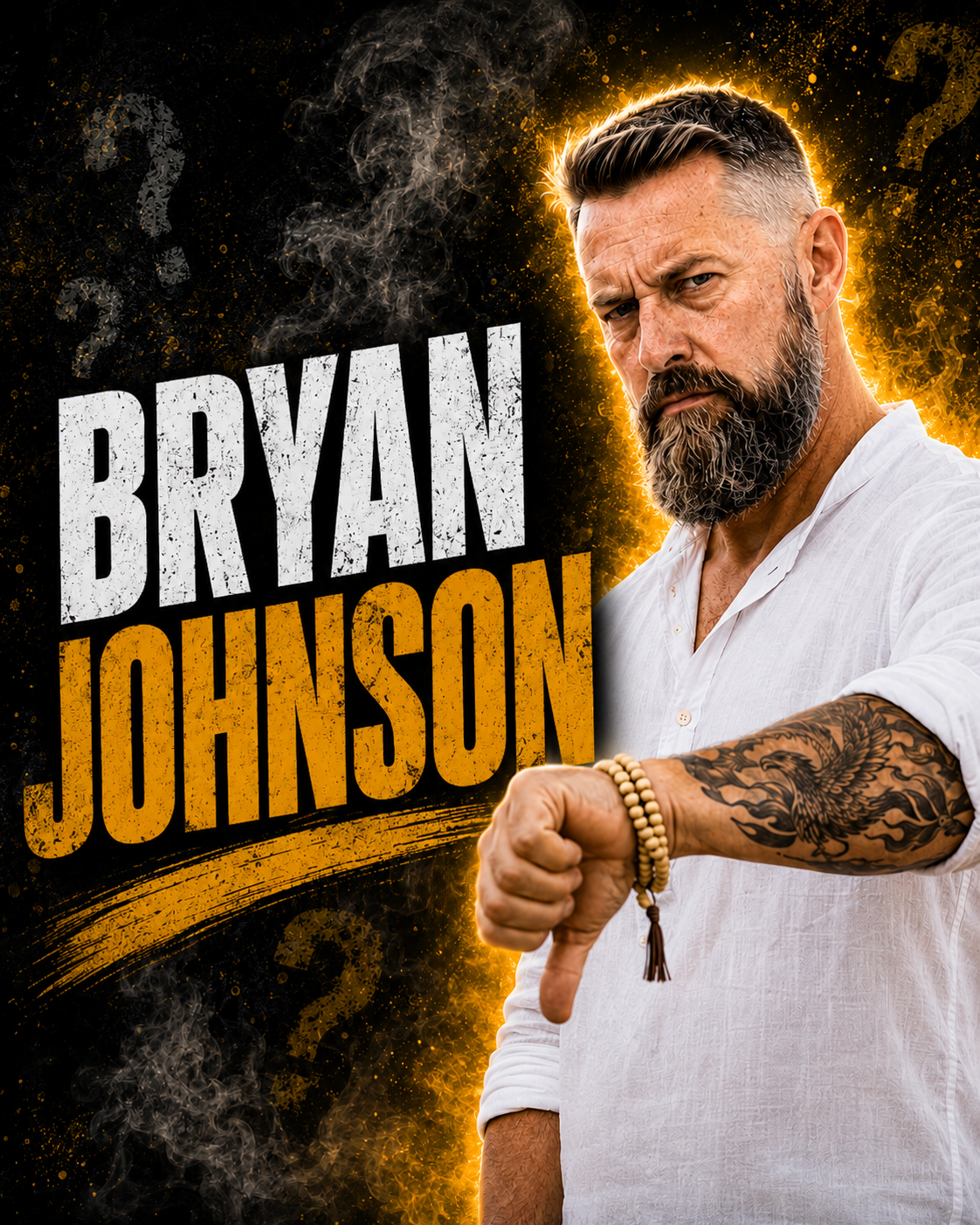

Bryan Johnson, Biohacking & Threat of Transhumanism
In this week’s article, I’ll start by acknowledging that I am a bad person.
My better human nature knows I shouldn’t celebrate another person’s suffering.
Nevertheless, I have to admit to experiencing a certain amount of schadenfreude when I learned that Mr. “Don’t Die” himself, health influencer Bryan Johnson, recently announced on X that he has been diagnosed with autoimmune gastritis, or AIG.
In Johnson’s own colorful description:
“My stomach is eating itself.”

AIG is a chronic autoimmune condition in which the immune system attacks the cells in the lining of the stomach. These cells produce stomach acid and intrinsic factor, a protein required to absorb vitamin B12. As the damage progresses, AIG can interfere with iron and B12 absorption and eventually contribute to pernicious anemia and other complications.
Who’da thunk that avoiding the sun, meat, and chugging artificial supplements by the fistful would wreck your gut?
The irony is a little hard to ignore.
Especially because I had already planned to write about Johnson this week before the news dropped, but for a different reason.
I have been critical of him in the past. To my eye, he looks more like a prisoner of war than the “healthiest human alive.”
His diagnosis may not prove causation, but it certainly does not inspire confidence in the experiment, particularly when we consider the many, many, many current or former vegans all suffering from some sort of nutrient deficiencies and/or chronic gut issues. (Yes, folks, plants do, in fact, contain many mildly toxic compounds to deter predators; combined with disruptions in our gut microbiomes from exposure to antibiotics and Roundup, people have become increasingly sensitive to fiber).
Without exception, every vegan I have ever met was pasty, gray, and frail; always tired, sick, or injured, and more than a little unbalanced.
Before I start sounding like sour grapes, let me be clear: I don’t resent Johnson’s success. More power to him. I would love to reach as many people with my message as he does. Johnson is simply better at that than I am.
My beef with Johnson (and those like him, like Silicon Valley biohacker bros like Dave Asprey) rests on five pillars:
- Biohacking is bullshit
- Vegan advocacy
- Fragility rather than resilience
- Transhumanism
- Imago Dei
The Map Is Not the Territory
It should be no secret by now that I am a big fan of the Ancestral Model of health and performance.
In my opinion, the Paleolithic, before the die-off of big game, was humanity’s true Golden Age. Ask yourself, “Why did the Natives of North America, or the Polynesians, never advance beyond Stone Age technology?”
My answer is: “Because they didn’t need to.”
“Evolution turns the unavoidable into the necessary.”
Moises Velasquez-Manoff
The abundance of fish, game, and natural forage, and even periods of scarcity, meant those people had everything they needed, with a Stone Age level of technology, to live out the full human experience.
As a counterpoint, one might note that the “average life expectancy was 35,” but the “average” is driven mostly by high child mortality and a lack of critical care. If you made it to adulthood (and didn’t die in combat, admittedly, both big “ifs”), your odds of reaching 70 or 80 were about the same as they are today, and regardless, short of the asteroid I pray for daily, going back to a Stone Age existence is not realistic.
Given that, what does it mean for us today? It means that we should think from first principles.
What environmental conditions shaped our physiology?
What signals does the human body expect to receive from food, sunlight, movement, temperature, microbes, sleep, danger, relationships, and the natural world?
Science writer Moises Velasquez-Manoff summarized the principle in a line I have quoted for years:
“Evolution turns the unavoidable into the necessary.”
When something remained present in the environment for hundreds of thousands—or millions—of years, evolution didn’t merely help us tolerate it; our physiology often came to depend on it.
That is the ancestral perspective in a nutshell.
Biohacking Is Bullshit
While a superficial pass of “biohacking concepts” might seem to pass the sniff test when discussing the basic principles of ancestral health models, in reality, they are diametrically opposed.
Biohacking takes many of the basic premises of Ancestral Health, and twists (if not inverts) them.
The Ancestral Model says nature has rules, and our job is to understand them well enough to live in harmony with them (even in a modern context). I am not a Luddite fundamentally opposed to the appropriate use of technology; however, the technology (and, by extension, biohacking) has some severe limitations.
I have written previously about the fallacy of chasing individual biomarkers in my article on fitness trackers. The premise of the “quantified self” assumes that we know enough about how the human system (and all its interrelated sub-systems) actually works that we can optimize human function by tweaking individual markers, and in many cases the mainstream medical consensus about any given marker is just flat-out wrong anyway (vis-a-vis cholesterol).
Using Johnson as an example again, he assiduously avoids the sun “because skin cancer.” Despite their stance on sun exposure and skin cancer, dermatology’s own published peer-reviewed literature shows repeatedly that those who get the most sun exposure have the lowest rates of mortality.
Even if we subdivide into groups of skin cancer/no cancer, those within the cancer group who get the most sun still generally live longer than those who get the least.
Emerging research in biophysics, which seeks to understand the role of light and electromagnetism in biology, provides evidence that sun exposure may help us require less food (up to a point) by facilitating the flow of electrons throughout the body, improving our “energy efficiency.”
While some self-proclaimed biohackers embrace the sun because it increases our levels of testosterone or vitamin D, sun exposure is so much more than that, and the odds that we have even already identified all the beneficial wavelengths of solar energy and the precise dose are close to zero.
Vitamin D is a great example of an individual biomarker that becomes the tail wagging the dog.
If vitamin D is actually just a proxy for sun exposure, artificially raising your blood levels through supplementation without actually getting exposure wastes time and money, which is why the peer-reviewed literature on supplemental vitamin D is so mixed. The most important benefits don’t come from the vitamin D itself; they come from the sun. Get enough sun, and the biomarkers take care of themselves.
While there are some supplements and metrics I find useful (like resting heart rate, blood sugar) on a week-over-week basis, chasing individual biomarkers is a fool’s errand.
Wearables can provide useful information, but dependence on a device can weaken our sense of personal agency and our natural ability to sense what is happening inside our own bodies. A watch tells you that you slept well, so you ignore the fact that you feel like hammered dog shit. Or it gives you a lousy recovery score, so you decide you must be exhausted despite having actually slept just fine.
To paraphrase the great Robb Wolf, our best three metrics are still:
- How do I look?
- How do I feel?
- How am I performing?
The Cultivation of Fragility
I recently listened to an episode of the Matt Walsh podcast, and he helped bring into sharp focus some of the thoughts I had been having about the so-called healthmaxxing trend: it’s doing precisely the opposite of its stated goal; rather than building robustness, it’s cultivating fragility.
Bryan Johnson figures prominently here, but he’s hardly alone.
A recent clip that made the rounds online was a discussion between Chris Williamson and Steven Bartlett on Diary of a CEO. Bartlett claimed that three glasses of wine wrecked his productivity for the next three days.
How far have we fallen from the days when men could drink all night, get into a bar fight, sleep for four hours, and still show up for work the next morning? The men of my grandfather’s day often worked their entire lives without ever taking a single sick day.
Those men weren’t “optimized,” and they certainly didn’t worry about trends like “healthmaxxing.” They got up in the morning, and they got shit done.
They were resilient. Compare that to Johnson, who cancels his whole life whenever he doesn’t sleep well.
Does that sound like resilience, or fragility?

What Is Health?
People have spent decades trying to define health comprehensively.
But I think there’s a simple definition: health is resiliency, reserve, or the ability to bounce back. Chris Masterjohn recently wrote a short piece titled “Your North Star” that I think largely mirrors my own perspective.
How much life do you have in your years? (A point we will return to at the end).
How much punishment can you absorb before you stop being useful? How much disruption can life throw at you before you can’t train, can’t think, can’t work, can’t take care of your family?
Another way to think about it is to compare different kinds of vehicles.
An electric car is incredibly efficient—right up until the lights go out. Then it’s just a very large, very expensive paperweight.
A diesel truck can keep working much longer under adverse conditions. One that’s been converted to run on a wood gasifier can keep running even after the fuel infrastructure has collapsed altogether.
If your health only exists under perfect conditions—perfect sleep, perfect meals, perfect supplements, perfect recovery, perfectly controlled stress—then you don’t have health.
You have dependence.
Real health isn’t about functioning only when every variable is optimized. It’s the ability to be useful under the widest possible range of conditions for as long as possible.
Vegan Advocacy
I’ll freely admit to becoming more conservative throughout my 30s and 40s; however, what I think people should do and what they must do are two completely different things, and fundamentally, my core libertarian values from my youth remain intact (albeit with some more nuance), so if somebody wants to wreck their health by pursuing a vegan diet, that’s their business.
However, the problem is that you very seldom meet a vegan who is not also an activist.
Activists gonna do activist shit, and much like the “broccoli has more protein per calorie than steak”, their activism is very frequently based on lies to justify what is ultimately a purely ideological position, and sooner or later, it becomes an argument about how everyone else should eat.
I’ve been alive long enough to see veganism go from being that weird fringe thing that only the occasional straight-edge skater and Marxist-inspired anti-establishment types were doing to becoming mainstream.
Once the advocacy reached a certain level of popular support, combined with corporate profit motives, it became a policy argument, and now it’s everybody’s problem.
Now meat is becoming stigmatized, taxed, restricted, or made artificially expensive in the name of health, climate, or planetary necessity, to the point that “credentialed experts” are making the case it’s perfectly ethical to genetically engineer the population to be allergic to meat vis-à-vis Alpha Gal, and that the resulting physcially smaller population would actually be a good thing because they would require less resources.
Dismantling the vegan dogma results in cries for more censorship because “misinformation.”
My concern is not that Johnson personally refuses to eat steak, but that the worldview he helps promote will mean that ordinary people lose access to one of the most nutrient-dense foods available and that a fundamental aspect of American culture is systematically dismantled, all while the wealthy and politically connected continue to buy whatever they please.
As we saw during COVID, and as we see every year when the elite gather in Davos, the rule is usually simple: Rules for thee, but not for me. They demand we eat ze bugz while they eat Wagyu and caviar.
Transhumanism Is An Existential Threat
I’m not aware that Johnson has ever identified himself specifically as a transhumanist, but if it walks like a duck and quacks like a duck, well, then it’s usually a duck.
Transhumanism, at its core, is the belief that human biology is not an endpoint but a platform—something to upgrade, optimize, and eventually transcend through technology. It frames the body as hardware and consciousness as software, both subject to human intervention.
While this may sound abstract or distant, the early stages are already here.
In the present day, nowhere is this better understood than through the trans debate, where advocates claim that biology is not fixed and can be modified through surgical and hormonal interventions to align with self-proclaimed identities.
Limiting the discussion strictly to hardware- continuous glucose monitors, cochlear implants, and even everyday wearables like Garmin devices or Apple Watches has begun to blur the line between organism and machine.
In their current form, these technologies can be useful. They democratize access to data that was once locked behind clinical walls. You can now see, in real time, how your blood sugar responds to a meal, how your sleep cycles fluctuate, or how your heart rate adapts to stress. But crucially, these tools do not remove agency. You can still choose to eat foods that spike your glucose. You can ignore the data. Free will remains intact. This mirrors the early days of the internet—an open frontier that democratized information and expanded free speech. Knowledge became widely accessible, gatekeepers were bypassed, and individuals had unprecedented autonomy in what they consumed and shared.
But that phase didn’t last.
Over time, the digital landscape consolidated. Information became fragmented behind paywalls, subscriptions, and algorithmic control. Access was no longer free; it was rented. Now extend that trajectory forward. What happens when the interface is no longer in your hand, but in your head? When every human being has a direct link to the cloud? Today, if you read a physical book, whatever you retain is yours. It lives in your mind, shaped by your interpretation and memory. But in a fully digitized cognitive ecosystem, what does ownership even mean? If information can be downloaded instantly, it can just as easily be revoked. Access becomes conditional. Memory becomes a service. We have already been warned that by 2030, we will “own nothing and be happy.”
The question is whether that extends beyond physical goods into the realm of experience itself. Imagine being told that access to your own memories—your wedding day, the birth of your child—requires a fee.
“Your access has expired. Please renew for $29.99 to revisit this moment for the next 24 hours.” At that point, identity is no longer intrinsic. It is licensed.
And what of silence? What of solitude? Will there still be such a thing as a quiet moment, or will even our inner landscape be monetized—ads playing not on screens, but directly within the mind? Beyond the tokenization and commodification of the entire human experience lies a deeper threat: the erosion of liberty and autonomy.
If your brain has access to the internet, then the internet, by definition, has access to your brain. Privacy ceases to exist at the most fundamental level. Thought itself becomes observable, trackable, and potentially regulated. What happens when a governing body—or any centralized authority—can monitor and intervene in your innermost thoughts? Would dissent even be possible? Or would it be flagged in real time:
“Sorry, comrade, you are engaging in prohibited thoughts against the state. These thoughts have been restricted. Your digital currency has been frozen for 30 days. A fine has been issued and automatically deducted from your Universal Basic Income.”
Compliance would no longer be a choice; it would be enforced at the biological level. And if this trajectory continues, intervention may begin before birth. Through gene editing, biochemical modulation, and pre-programmed developmental pathways, compliance could be engineered into the system itself (for the good of all, of course)—long before an individual has the capacity to question, much less consent to it.
Imago Dei, Or Zen Is Learning How To Die
Once health ceases to be a path of stewardship and instead becomes life’s highest purpose, the body simply becomes raw material, a resource to be exploited, and death itself becomes the enemy.
The ancient Stoics understood something we’ve largely forgotten: Memento mori, “Remember death.”
Not only because death is inevitable, but because remembering your mortality changes how you live. Every day becomes precious precisely because it is finite. Zen master Shunryu Suzuki said, “Treat every moment as your last. It is not preparation for something else.” Death is the horizon against which a meaningful life is lived.
After watching Johnson and others like him, I’ve come to believe that beneath all the biomarkers, supplements, MRIs, and optimization lies something much simpler: they are terrified of their own mortality.
Technology offers the false promise of fleeting hope that they can stop the sands of time from moving through the hourglass; a desperate escape pod from which they can eject themselves into an illusion of eternal safety from the ever-sinking Titanic of human life.

In an increasingly Godless, tech-driven secular world, transhumanism is inevitable.
If there is no transcendent reality (or responsibility) beyond the material world, then salvation itself must become material. We begin by extending lifespan through better medicine, better nutrition, and better technology. Then we talk about genetic engineering, artificial organs, brain-computer interfaces, and, eventually, preserving consciousness itself in digital form.
It stands in direct opposition to one of the oldest ideas in the Judeo-Christian tradition: imago Dei.

We Are Made In The Image of God
Imago Dei simply means “the image of God.” It is the belief that mankind possesses inherent dignity and perfection, as we are, because we were created by God in his image. That has profound implications for how we view our body and our lives.
My body is not my property; it is not a machine that I own absolutely, free to modify without limit in pursuit of perfection; rather, it is a gift entrusted to me. I am its steward, not its owner.
We train. We eat well. We sleep. We recover. We care for our bodies because faithful stewardship requires it. A soldier maintains his rifle. A craftsman sharpens his tools. A martial artist conditions his body, but none of those things exist for their own sake.
Faith (or wisdom at any rate) doesn’t eliminate the reality of death, but it does change our relationship with it.
“They’re doomed.”
“Yes… but a thing isn’t beautiful because it lasts.”
Transcend The Duality of Life & Death
Zen became fashionable among Silicon Valley types, in part because it seemed to offer spirituality without God. Meditation, mindfulness, breathing exercises—all stripped from their original context and repackaged as tools for increasing productivity.
Mindfulness became an essential item of every optimized TechBro™ morning routine; non-judgment a self-congratulatory “Sorry, not sorry” apology for every nihilistic, self-absorbed pursuit of materialism, indulgence, general asshole-ry, and effective altruism, where the ends justify any means (despite the ends never aligning with the stated goals).
The Old Master Suzuki Shōsan argued that the true purpose of Zen was learning how to die, to move beyond the false duality of life and death as opposites.
Transhumanism stands diametrically opposed to the wisdom of the Old Masters who sought to change the person who must face death from within, and is an enemy of human flourishing. For all their success, Johnson and those like him are essentially pulling up the ladder behind them.

Read More!
- Choose Tradition Over Tech

- What “Reality-Based” Martial Arts Actually Means

- The Case For Training Low-Percentage Martial Arts Techniques

- The Surprising Ways Dogs Protect Us

About the Author

Ashe Higgs, I Liq Chuan Master Instructor & L2 Nutrition Coach
Ashe is a highly skilled martial arts instructor and certified nutrition coach with over two decades of experience in the field. He holds a Master Instructor certification in I Liq Chuan under Sam FS Chin, making him one of only several individuals worldwide to hold the title. He has taught classes and workshops worldwide and is passionate about helping others achieve their fitness and wellness goals.
With a background in full-contact fighting and a Level 2 certification from Precision Nutrition in nutrition coaching, Ashe is a well-rounded expert in the fields of martial arts. In addition to his expertise, he has a wealth of experience in teaching and mentoring others. He has a natural ability to connect with his students and inspire them to reach their full potential.
Disclaimers & Conflicts of Interest
I am not a doctor or a lawyer, and the information provided should not be considered medical or legal advice.
The information provided is for educational and informational purposes only and should not be used as a substitute for professional legal or medical advice, diagnosis, or treatment. Consult your doctor or a qualified healthcare professional before making any changes to your diet, exercise routine, or lifestyle.
Please note that some of the links provided in this content may be affiliate links, meaning that I may receive a small commission if you purchase through them. However, please rest assured that any products or services recommended are based on my personal experience and belief in their value. I only recommend products or services that I have personally used and believe in.