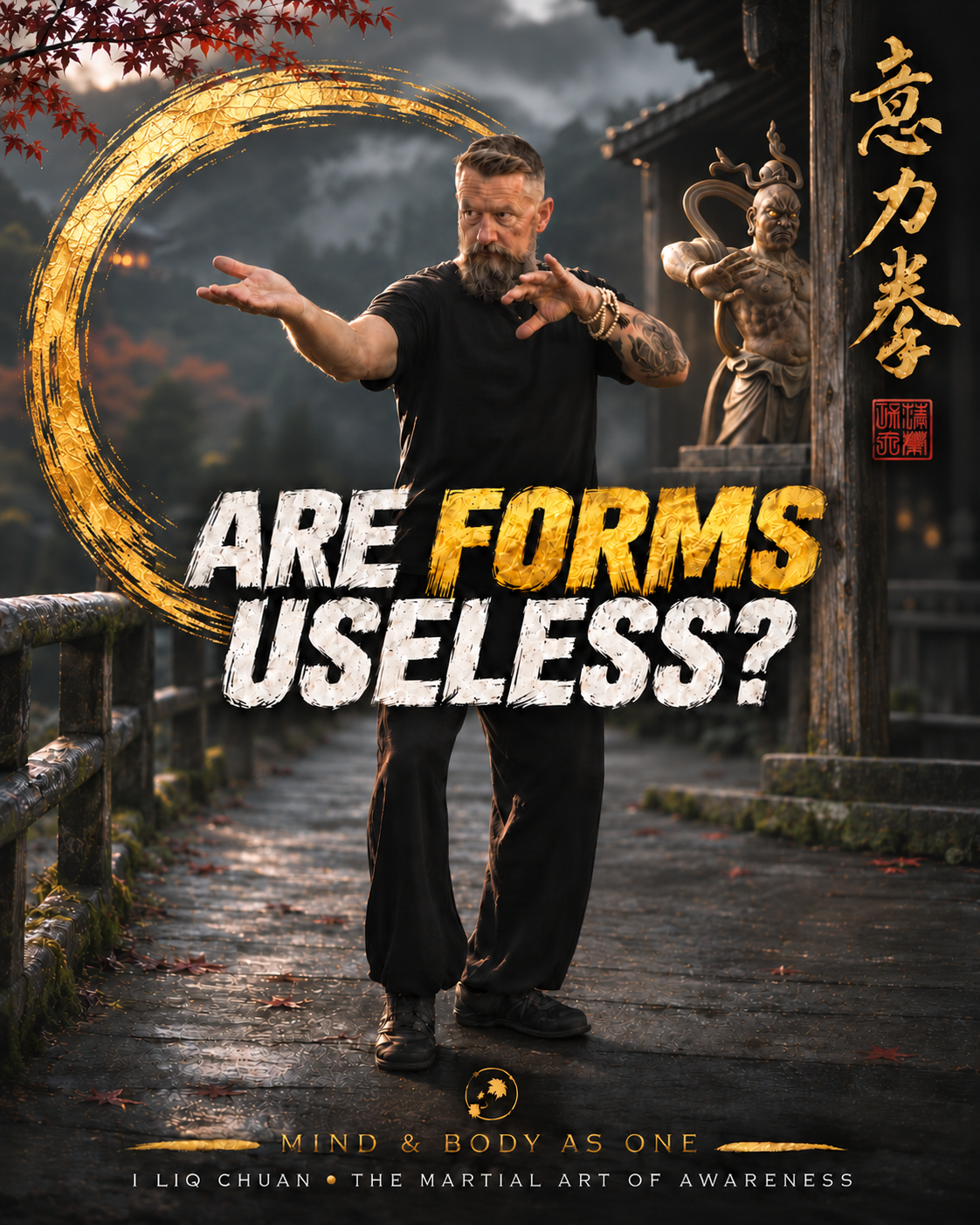
Are Kata/Forms Useless?

Spend any time around martial artists, and you’ll hear someone argue that they are.
And there’s an obvious truth behind that criticism: you cannot learn how to fight simply by practicing forms.
If all you ever do is rehearse predetermined movements against an imaginary opponent, you’ll never develop the timing, distance, adaptability, pressure management, or decision-making required to deal with another human being who is an active threat to your safety, or attempting to use force against you.
Forms Are Not Necessary to Learn How to Fight.
But “not necessary” and “useless” are not the same thing.
The problem is that discussions about forms tend to become binary. Either forms are treated as indispensable repositories of ancient fighting knowledge, or they’re dismissed as useless choreography that has no place in serious martial arts training.
I don’t think either position is particularly useful.
Forms are a training tool. Like any training tool, they have a specific purpose, particular advantages, and obvious limitations.
The important question isn’t whether forms “work.”
What are they useful for? Where do they fit within the larger training process, and where does their usefulness end?
Forms as Physical Training
Before we get into I Liq Chuan specifically, it’s worth considering what traditional martial arts forms may have originally been intended to accomplish.
One hypothesis I find compelling—although I want to be clear that this is mostly speculative on my part—is that many of the more physically demanding traditional forms were never intended primarily as catalogs of fighting techniques.
As I have written about elsewhere, physical capacity is the single most important factor when it comes to the use of force. Some of the more explosive/gymnastic forms may have functioned, at least in part, as progressive strength and conditioning programs.
Look at some traditional Chinese martial arts forms from that perspective and certain things begin to make more sense.
Deep stances, extended positions, explosive changes of direction, large ranges of motion, jumps, kicks, prolonged sequences, and mechanically disadvantageous positions don’t necessarily resemble optimal, or even realistic fighting patterns.
But they make considerably more sense as strength and conditioning routines.
Anyone familiar with calisthenics or gymnastic strength training understands the principle.
If you don’t have access to barbells, machines, or easily adjustable external resistance, you can increase difficulty by manipulating leverage, range of motion, speed, stability, and your body’s relationship to gravity.
A position with poor leverage may be a terrible place to fight from while simultaneously being an excellent position from which to develop strength.
Remember that the martial artists who developed these methods didn’t have access to a modern commercial gym. If you wanted to progressively challenge the body, you had to work with what you had.
And what everyone had was gravity.
Different forms within a system could therefore provide increasing levels of physical difficulty. A beginner learns something relatively simple. More advanced forms demand greater strength, mobility, coordination, explosiveness, endurance, and control.
There may even have been a selection function involved.
Historically, martial knowledge was closely guarded. A teacher whose livelihood—or even survival—depended upon his martial skill had reasons to be selective about whom he taught.
It’s at least plausible that increasingly demanding forms provided a way to determine which students had the physical capacity, discipline, and persistence required to progress deeper into the system.
If you couldn’t meet the demands of one level of training, perhaps you simply didn’t advance to the next.
Again, I’m presenting that as a hypothesis rather than established historical fact.
But I shouldn’t need to prove the selection hypothesis to recognize the more basic point:
Traditional forms can provide progressively more demanding physical training.
But that still doesn’t explain their full value.
From Vocabulary to Sentences
Within I Liq Chuan, it helps to understand forms in relation to the rest of the training process.
I tend to think of the system as having three broad areas.
One half is the process of unifying the mental and physical—what we might call developing mind and body as one.
The other half is learning to unify, or flow, with a partner.
Surrounding both are the art’s philosophy, concepts, and principles. Borrowing an old Zen analogy, they are like the “elephant’s footprint”: everything else fits within them.
Within the first area, we begin with basic exercises, or jibengong 基本功.
These exercises isolate specific movement patterns.
Rather than beginning with the idea that “this is a punch” or “this is a block,” we can investigate something more fundamental: How does the human body actually move?
We can examine movement through the horizontal, frontal, and sagittal planes. We can investigate inward and outward movement, clockwise and counterclockwise rotation, opening and closing, rising and falling.
Each movement pattern has certain strengths.
Each also has limitations.
That follows directly from the principle of yin and yang. Every particular function, by definition, comes with particular constraints.
Or, as I sometimes like to put it:
Every superpower is also its own kryptonite at the same time.
The basic exercises let us isolate these movements so we can investigate and optimize them.
If jibengong establishes the basic vocabulary, forms teach us to begin constructing sentences.
Instead of optimizing a single movement pattern based on first principles in isolation, we now have to maintain those same principles while linking different patterns together.
We change planes.
We change directions.
We step.
We turn.
As we move, our center of mass can shift relative to our base of support. The objective is to maintain balance throughout these transitions, preserving the relationship between our center of mass, our base of support, and the force of gravity.
The problem becomes progressively more complex.
And the transition itself becomes part of what we are training.
The 21 Form and Fullness
Grandmaster Sam Chin calls I Liq Chuan’s 21 Form the “Fullness Form.” That characterization tells us something critical about its purpose. The objective isn’t simply to arrive at the correct posture at the end of each movement like a snapshot.
The entire movement has to maintain the appropriate qualities.
Grandmaster Chin uses the analogy of a circle and a line; a circle can be understood as a continuous line, but that line itself consists of “all the dots.” Each individual point must be complete.
Likewise, when moving through the form, it isn’t enough for position A to be correct and position B to be correct.
What happens between those two positions? That’s where the real work begins.
It’s easy enough to move from one pose to another and convince yourself that you’ve found the correct end point. But continuous movement is another matter entirely. As soon as the body begins to move, the relationship between our center of mass and base of support, upper extremities, etc., all begin to change.
The challenge is to move without losing the relationships between all the parts we’ve worked so hard to establish. Can we maintain our balance, structure, and fullness throughout the transition, or do those qualities disappear somewhere along the way?
A broken line doesn’t become continuous simply because its endpoints are technically correct based on outward appearance. As GM Sam Chin says, “You must change with the change [to maintain].”
Every point between A and B must be complete.
This brings us to one of the most important concepts in I Liq Chuan: balance.
Balance Is the Ability to Change
In ordinary conversation, we tend to think of balance as simply not falling over.
Within I Liq Chuan, we’re interested in something more demanding.
The practical expression of balance is the ability to change.
If I step forward and overcommit my weight, I may still be standing upright. In the ordinary sense, I’m “balanced.”
But what happens if I suddenly need to move backward?
Momentum must now be overcome before I can reverse direction.
From our perspective, something has already been lost.

We therefore examine two important qualities during solo training: balanced body and balanced movement.
Balanced body begins with the relationship between our structure and gravity.
We’re looking for joint relationships that allow compressive forces to transfer efficiently through the skeleton, so that the geometry of the bones does as much of the work as possible while unnecessary muscular tension can be minimized.
Ultimately, this relationship shows up in the balance point on the feet. If our weight drifts excessively into the heels or toward the toes, our ability to change has already been compromised.
There is also a soft-tissue component involving the natural actions and relationships of the muscles, tendons, and other tissues. Some aspects of this are extremely difficult to communicate adequately through writing and are better understood through direct instruction and touch, so they are beyond the scope of this article.
Balanced movement adds another layer.
If force moves forward, it must also have an appropriate relationship backward. Up must be understood in relation to down. Left exists in relation to right.
And when I use the word “energy” to describe these relationships, I’m not referring to anything mystical. I’m talking about the forces involved in producing and controlling movement (i.e., kinetic energy).
Balanced body and balanced movement give us the foundation for maintaining our capacity to change.
And forms provide an increasingly complex environment in which to investigate that capacity.
Don’t Train Faster Than Your Attention Can Keep Up With
This is where another function of forms becomes important. They aren’t merely physical exercises; they can also function as dynamic meditation.
Grandmaster Sam Chin often asks:
“Do you see the head, the middle, or the tail?”
Every change has a beginning, a middle, and an end, but whether we actually perceive those stages depends upon the quality of our attention. If movement happens faster than our attention can follow it, we may only recognize the tail—the final snapshot. We recognize the effect without having perceived the process that created it.
This is why I frequently tell students: “Don’t train faster than your attention can keep up with.”
Slowing down isn’t valuable because slow movement is somehow inherently superior in any tactical sense.
We slow down because speed has to match our current capacity for attention. At speed, we will always default to baseline programming (i.e., habitual reflex). If you’re fortunate enough to be naturally athletic, maybe you can get away with this, but even then, there’s no guarantee that, no matter how fast and explosive you are, your reflexive reaction will be the right action, meaning that your action aligns with the conditions, rather than trying to jam square pegs into round holes.
At an appropriate speed, we can observe changes in weight distribution, joint angles, muscular tension, balance, and structure as they happen.
As our ability to perceive those changes improves, the demands of the exercise should increase proportionally.
The Value of Language Is In Shared Meaning
Another important use of forms is that they provide a common reference point between teacher and student. Many of the qualities we’re trying to develop in martial arts can be difficult to understand in the abstract. Words like balance, fullness, relaxation, connection, or alignment can mean very different things to different people. A form gives us a controlled, repeatable context in which those ideas can be tied to something concrete and observable.
Because the movement is predetermined, both teacher and student know what is supposed to happen next. That removes some of the variables that would otherwise be present in partner training. The instructor can look at a particular movement, transition, or position and ask specific questions: Where is your weight? What is the relationship between these joints? Could you change direction from here?
Instead of discussing an abstract principle in the abstract, we now have something we can repeatedly observe, adjust, and test.
Eventually, though, the student has to move beyond simply reproducing the outward appearance of the form. The penny drops when the student begins to recognize the internal feeling associated with the correct quality of movement. The external reference points help guide the student toward that recognition, but once the student knows what they’re looking for—or, more accurately, what they’re feeling for—they have a reference point they can begin to reproduce elsewhere.
That becomes especially important as we ascend the ladder of progressive intensity.
The controlled environment of the form gives way to increasingly demanding partner exercises, where more variables are introduced, and the student has less time and attention available for conscious correction. The conditions change, but the quality we are trying to maintain does not.

The student can now ask: Can I reproduce the same balance, fullness, alignment, and capacity to change when another person is touching me? When the movement is no longer predetermined? When I have to react? When my partner begins actively resisting me?
In that sense, the form is not the destination. It provides a controlled laboratory in which certain qualities can be isolated, recognized, and reproduced before we attempt to maintain those same qualities under progressively more difficult conditions.
Forms As Dynamic Meditation
This brings us to the philosophical foundation of the practice.
Zen is ultimately concerned with direct knowing—knowing through immediate experience rather than merely through words and concepts.
In practical terms, we can start with self-awareness.
Traditional Zen practice describes four basic meditation postures: sitting, standing, walking, and lying down.
Each provides a different context for cultivating attention.
But there is also a traditional progression in what we learn to observe: mindfulness of the body, feeling, mind, and phenomena.
We begin with the body for a very practical reason; the body is material. It is relatively obvious, and we can observe many of its qualities objectively. Shifting our weight is easier to recognize than a fleeting change in emotion or thought. The pressure distribution beneath your feet is relatively coarse compared with increasingly subtle changes in the mind. So we begin with what’s easiest to notice.
We learn to stabilize attention using the body as our reference point.
From there, progressively subtler phenomena become available to observation, and ultimately, what we learn to recognize is change itself.
- Beginning.
- Middle.
- End.
Forms create a more complicated environment in which to practice that awareness.
Standing meditation requires attention with constant subtle adjustments to maintain our posture in response to continuously changing internal and external variables like our breathing, heartbeat, the wind blowing or changing direction, etc.
Walking meditation adds more complex movement and additional variables.
A martial arts form adds considerably more complexity: changing directions, changing planes, coordinating the limbs, transferring weight, maintaining structure, regulating tension, and continuously adjusting our relationship to gravity.
Some forms add substantial physical demands on top of that.
This gives us another kind of progressive overload—not simply of the muscles, but of coordination and, ultimately, attention.
The movement becomes more complicated while the baseline requirement remains the same:
Can you recognize what is happening as it happens?
Where Forms Fit
Without any hesitation or reservation, I will happily agree that forms are not fighting.
They cannot teach you to deal with an unpredictable opponent on their own. They cannot replace partner training, resistance, pressure, timing, distance, or actual application.
Within a progressive model of martial arts training, forms remain rehearsed practice. The sequence is predetermined. You need to understand that limitation clearly. But rehearsed does not mean useless.
Basic exercises allow us to isolate individual movement patterns and optimize them.
Forms ask us to maintain that optimization as individual patterns link into increasingly complex sequences.
Partner training introduces multiple, complex external variables.
Reactive training introduces uncertainty.
Resistance introduces opposition.
Each step creates problems that the previous level cannot provide.
That is precisely why no single training method should be expected to do everything. The mistake is asking forms to solve a problem they were never designed to solve. A form doesn’t need to teach you how to fight in order to have value any more than lifting a barbell needs to resemble a fight to make you stronger.
The better question is whether the training develops qualities that contribute to the larger process.
Used appropriately, forms (in some cases) can develop physical capacity, progressively increase movement complexity, provide an environment for optimizing movement, cultivate attention, and teach us to recognize increasingly subtle changes within ourselves.
Then we take those qualities somewhere forms cannot take us.

Read More!
- Are Martial Arts Forms Useless?

- Choose Tradition Over Tech

- What “Reality-Based” Martial Arts Actually Means

- The Case For Training Low-Percentage Martial Arts Techniques

About the Author

Ashe Higgs, I Liq Chuan Master Instructor & L2 Nutrition Coach
Ashe is a highly skilled martial arts instructor and certified nutrition coach with over two decades of experience in the field. He holds a Master Instructor certification in I Liq Chuan under Sam FS Chin, making him one of only several individuals worldwide to hold the title. He has taught classes and workshops worldwide and is passionate about helping others achieve their fitness and wellness goals.
With a background in full-contact fighting and a Level 2 certification from Precision Nutrition in nutrition coaching, Ashe is a well-rounded expert in the fields of martial arts. In addition to his expertise, he has a wealth of experience in teaching and mentoring others. He has a natural ability to connect with his students and inspire them to reach their full potential.
Disclaimers & Conflicts of Interest
I am not a doctor or a lawyer, and the information provided should not be considered medical or legal advice.
The information provided is for educational and informational purposes only and should not be used as a substitute for professional legal or medical advice, diagnosis, or treatment. Consult your doctor or a qualified healthcare professional before making any changes to your diet, exercise routine, or lifestyle.
Please note that some of the links provided in this content may be affiliate links, meaning that I may receive a small commission if you purchase through them. However, please rest assured that any products or services recommended are based on my personal experience and belief in their value. I only recommend products or services that I have personally used and believe in.