Welcome back to Fit-To-Fight, the series where ancient practice meets modern science in pursuit of a more natural way of living — and a more capable version of you.
This week’s installment is a little shorter and a little more casual than usual, but it connects a few dots I think you’ll find interesting. I recently came across a study that ties together themes from several past articles, and it has some surprising implications for how we think about sleep, technology, and the power of the mind.
Let’s get into it.
Guard Your Sleep
If you’ve been following along, you already know that sleep is the martial arts performance enhancer most people overlook. We covered how, under the stress–recovery–adaptation model, training only pays off if recovery — chiefly 7–8 hours of quality sleep — allows your body and brain to actually adapt. We talked about the physical repair, the skill consolidation, the emotional regulation, the immune function — all the reasons martial artists should guard their sleep jealously.
So we already know sleep matters. But here’s the question: does believing you slept well matter too?
Turns out, it might matter more than you think.
The Placebo Sleep Study
A study published in the Journal of Experimental Psychology: Learning, Memory, and Cognition by Christina Draganich and Kristi Erdal examined whether perceived sleep quality affects cognitive functioning — above and beyond how you actually slept. (Placebo sleep affects cognitive functioning)
Here’s what they did:
164 participants reported how well they slept the night before.
They were then randomly assigned to one of two conditions (or a control).
Some participants were told their sleep data showed above-average REM sleep — 28.7% of total sleep time.
Others were told they got below-average REM — only 16.2%.
Then everyone took a battery of cognitive tests.
The catch? The REM percentages were fabricated. Participants were randomly assigned regardless of their actual sleep.
The results were striking. The assigned sleep quality — not the self-reported actual sleep quality — significantly predicted performance on tests of attention and verbal fluency. People who were told they slept well performed better. People who were told they slept poorly performed worse. And it didn’t matter how they actually slept.
Let me say that again: it didn’t matter how they actually slept. What they believed about their sleep quality changed their cognitive performance.
Tech: Useful Servant, Poor Master
Now, think about what happens every morning when you wake up, roll over, and check your fitness tracker. Your watch tells you that your sleep score was a 62 out of 100. Deep sleep was “low.” Recovery is “suboptimal.” How does that little number shape the way you feel for the rest of the day?
We dug into this before when we asked whether fitness trackers are accurate, and the short answer was: heart rate, maybe. Calorie burn, not really. Sleep staging — based on an accelerometer guessing at your movement — almost certainly not. I shared the story of my own Garmin recording “deep sleep” while I was lying in bed reading.
The bigger point from that article was about interoception — the Old Masters’ instruction to “look within.” The idea that your own body awareness, trained through meditation, breathing, and mindful movement, is a more reliable internal compass than any wrist-worn sensor. Technology makes a useful servant, but a poor master.
But the placebo sleep study adds a new wrinkle. It’s not just that your tracker might be wrong. It’s that believing the tracker — even when it’s wrong — can actively change your performance. If your watch says you slept terribly, you may perform as though you did, regardless of what actually happened in the night.
That’s the nocebo effect in action, and it’s a strong argument for not letting a device set the tone for your day before you’ve even checked in with yourself.
The Power of the Mind
This shouldn’t come as a complete shock if you’ve been reading along. A few years back, we covered how the breath can be used to take control of the body — specifically, how the Wim Hof Method activates brain regions involved in pain modulation, self-reflection, and sustained attention. That study used fMRI to show that deliberate breathing and focused intent can influence processes we normally think of as fully automatic.
The placebo sleep study sits in the same family of findings: the mind isn’t just a passive passenger. What you believe, what you focus on, and what you expect can measurably change how your body and brain perform.
The connection isn’t that placebo sleep and cold exposure use the same mechanism — they almost certainly don’t. The connection is broader: mindset, attention, and expectation have real physiological and cognitive effects. That’s a thread that runs through traditional martial arts training (intent, yi, leading the body) and through modern neuroscience alike.
A Quick Note on Placebo Effects — More to Come
Here’s something worth flagging. The placebo effect is powerful enough that researchers have to design their studies carefully to separate what a treatment actually does from what belief in the treatment does. That’s why rigorous studies use placebos, blinding, and control groups — to make sure they’re measuring the treatment, not the expectation.
This matters for martial artists and fitness enthusiasts because we’re constantly exposed to claims about supplements, training protocols, recovery tools, and wearables. Understanding how placebo effects work — both the positive (placebo) and negative (nocebo) directions — helps you evaluate what’s actually working versus what’s just in your head.
But that’s a bigger conversation, and one I’ll save for a future installment.
The Takeaway
For now, here’s the practical takeaway:
Protect your sleep first. Nothing replaces 7–8 hours of quality rest.
Don’t let a tracker dictate your morning. If your watch says you slept poorly, but you feel fine, trust your body over the algorithm.
Use technology as feedback, not identity. Data is a tool for noticing patterns, not a verdict on your capability.
Train your interoception. The ability to sense your own internal state is a skill — and the Old Masters were right that it’s worth cultivating.
Notice how belief shapes performance. If you tell yourself you’re tired, under-recovered, or off your game, your body may just listen.
Training isn’t just muscles and techniques. It’s learning to regulate body, breath, attention, and mind. The more you understand the levers — including the ones you didn’t know you were pulling — the better your practice becomes.
Fit-To-Fight explores the intersection of ancient practice and modern science for martial artists who want to train smarter, recover better, and live more naturally.
Situational awareness is often touted as a key skill for identifying and reacting to potential threats. This focus on external vigilance is crucial but is only part of the equation. Equally important, though not as frequently discussed, is the role of self-awareness, particularly in high-risk scenarios. This concept was strikingly highlighted in a piece I recently came across by Coach Tony Blauer, a name synonymous with innovative self-defense techniques.
As a long-time instructor of I Liq Chuan – The Martial Art of Awareness, Blauer’s perspectives struck a chord with me, echoing many principles I have embraced and taught for two decades. Self-awareness is about more than being conscious of the threat in high-risk situations. It’s about understanding and managing our internal state – our thoughts, emotions, and physiological responses. This internal monitoring is crucial because it directly impacts how effectively we can apply our situational awareness. It’s the difference between simply recognizing a threat and being able to respond to it appropriately. In self-defense, awareness of both the environment and ourselves is I Liq Chuan’s “stock in trade,” a vital skill set for anyone looking to enhance their personal safety.
Situational Awareness and Its Levels in Self-Defense
Cooper’s Color Code: A Framework for Awareness
Lt. Col. Jeff Cooper, Arizona rancher, former Marine, and renowned firearms instructor, developed a color-coded system to describe different levels of situational awareness and readiness to respond to threats.
According to Cooper, the key to surviving a deadly encounter lies not in the weapon or martial abilities but rather in the combat mindset. This crucial concept is elaborated in his book, “Principles of Personal Defense,” where he emphasizes that the foremost tool in such situations is one’s mental preparedness and approach.
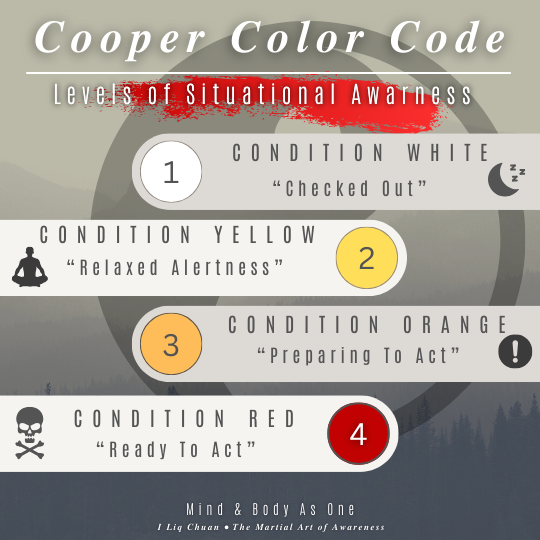
As currently taught, this system, known as Cooper’s Color Code, has become a foundational tool in self-defense and tactical training. It helps individuals gauge and adjust their level of awareness and readiness in various situations. The code consists of four colors, each representing a specific state of alertness:
White: In this state, a person is unprepared and unaware of their surroundings. They are not expecting any conflict or threat. This level of awareness is often seen in safe environments, such as one’s home.
Yellow: This is a relaxed but alert state. People in condition yellow are aware of their surroundings and are prepared for potential threats but do not actively identify any specific danger. It’s a state of general awareness that should be maintained in any unfamiliar or public environment.
Orange: In this heightened state of alertness, a person has identified a potential threat or anomaly in their environment. This doesn’t mean there is an immediate danger, but the individual is prepared to act if the situation escalates.
Red: This is a state of readiness to respond to an immediate threat. When in condition red, a person is ready to take action, having identified a specific threat that requires a response.
The Practical Application of Cooper’s Color Code
This system is not just theoretical; it has practical applications in everyday life and self-defense training. By understanding and applying Cooper’s Color Code, individuals can better prepare themselves for potential threats. For instance, staying in a state of relaxed readiness (condition yellow) in public places allows one to quickly shift to orange or red if a threat appears, thereby reducing reaction time.
In his book, The Martial Art of Awareness, GM Sam Chin writes, “The difference that distinguishes ‘you are walking, and I am walking’ is the concept of mindfulness. While there is no outer difference between ‘the two persons walking,’ there is an inner difference. One person may walk with his mind in another world, not even realizing he is walking. He may be thinking about other things in his life and forget to be in the moment. The other person may be practicing mindfulness and be totally in the moment.”
John Correa of Active Self Protection (A.S.P.) often emphasizes the importance of awareness by saying, “Awareness buys you time, and time buys you options.” This statement underscores the value of situational awareness in self-defense. By being aware, individuals can identify potential threats earlier, giving them more time to respond and more options to handle the situation effectively.
Beyond Awareness: The Integration of Self-Awareness
While situational awareness is critical, it’s only one part of the equation. Self-awareness, particularly in high-risk situations, plays a vital role in how we respond to threats. Understanding our internal state – our thoughts, emotions, and physiological responses – is crucial in these scenarios. This internal monitoring allows us to manage our reactions and make more effective decisions under stress.
For example, in a state of heightened alertness (orange or red), recognizing signs of panic or fear in oneself can be the difference between a calculated response and a rash decision. By being self-aware, individuals can regulate their emotions and maintain clarity of thought, even in high-pressure situations.
The Role of Self-Awareness in Managing Fear for Effective Self-Defense
Self-awareness plays a pivotal role in how we respond to threats and high-risk scenarios. In this context, managing fear and understanding our physiological responses like adrenaline dumps become crucial elements of effective self-defense.
In his seminal work on preparedness, Nuclear War Survival Skills, author Cresson H Kearny writes, “Fear often is a life-saving emotion. When we believe death is close at hand, fear can increase our ability to work harder and longer. Driven by fear, we can accomplish feats that would be impossible otherwise. Trembling hands, weak legs, and cold sweat do not mean that a person has become ineffective.”
Understanding and Managing Fear
Fear is a natural response to perceived danger. It’s an instinctive mechanism that prepares our body to either fight or flee. However, the way we handle this fear can significantly influence our ability to respond effectively in high-risk scenarios. An adrenaline dump, a universal human response characterized by a sudden surge of energy, is common in such situations. For the average person, especially those not accustomed to high-stress situations, this spike in fear and adrenaline can be overwhelming, leading to panic or freezing up.
Drawing from personal experience, I found distinct differences in my reactions in competitive and surprise scenarios. While fighting competitively in San Da, I experienced a significant adrenaline dump and needed to absorb a few hits to work through it. I was prepared for the fight; I knew it was coming. However, in situations where I was caught by surprise, my response was often one of complete Zen, a state of calmness and clarity amidst chaos.
The Impact of Uncontrolled Fear
Uncontrolled fear can have detrimental effects in a self-defense situation. It can cloud judgment, slow decision-making, and hinder the execution of learned self-defense techniques. In contrast, effectively managing fear can lead to more rational and strategic responses, utilizing training and situational awareness to their fullest.
The First Step: Recognizing Fear
Managing fear begins with recognizing it. It’s about being aware of the signs of fear in our body and mind. Zen mindfulness teaches that contact conditions feeling, and feeling conditions the mind. This awareness is the first step towards managing our response to it. Once we’re aware of these signs, we can start to employ strategies to regulate them.
Training to Manage Fear
The ability to manage fear is not innate; it requires practice and training. This can involve scenario-based training, where individuals are placed in simulated high-stress situations. This type of training allows individuals to experience and learn to manage their fear response in a controlled environment. Alongside physical self-defense techniques, this training helps build a more holistic approach to self-defense.
Techniques to Mitigate Fear
Several techniques can be employed to manage fear effectively:
Mindfulness Training: In this context, we simply recognize how we’re feeling without identifying with the feeling. Mindfulness teaches us to neither embrace nor reject what is there. By not identifying with our thoughts and feelings, we can just let them be and return our focus to the task at hand. I Liq Chuan, in particular, takes a unique approach to martial arts training as a tool specifically to develop mindfulness. Mindfulness is ultimately training for improved situational and self-awareness.
Positive Self-Talk: Encouraging oneself to affirm that one is still capable of action when experiencing an adrenaline surge can help maintain focus and confidence in stressful situations.
Mental Rehearsal: Visualizing and mentally rehearsing trained responses can prepare the mind to act more efficiently under stress.
“Meditation on inevitable death should be performed daily. Every day, when one’s body and mind are at peace, one should meditate upon being ripped apart by arrows, rifles, spears, and swords.”
The Hagakure
These techniques help mitigate the impact of fear, allowing for clearer thinking and better decision-making. Managing your response in a potentially life-threatening situation will likely involve some combination of all of these factors rather than applying them in isolation.
Regardless of how one prepares, when the SHTF for real, you never know if you’ll be the one to freeze. All we can do is our best, and when the moment comes hope we can rise to meet the occasion.
Instincts and Intuition: The Underappreciated Pillars of Self-Awareness in Self-Defense
In the context of self-defense, while much emphasis is placed on physical preparedness and situational awareness, an often-overlooked element is the role of our instincts and intuition. Though sometimes dulled by modern living and social conditioning, these innate capabilities should be our first line of defense.
Intuition as a Safety Signal
Our intuition often manifests not as a clear directive but as a vague feeling or a sense that something isn’t right. This gut feeling is an evolutionary tool, a subconscious collection of observations and experiences our conscious mind may not immediately recognize or understand. In situations that could lead to violence or danger, many victims of violent crime report that their gut told them something was off about their attacker before the attack occurred.
Trusting and Acting on Intuition
Trusting and acting on these intuitive signals can be the difference between reacting to a threat and avoiding it altogether. It’s about giving credence to that inner voice that alerts us to danger, even if we can’t immediately rationalize why we feel uneasy. This could manifest in various ways, such as crossing the street to avoid someone who makes us feel uncomfortable or leaving a situation that doesn’t feel right. When it comes to self-defense, the best fight is one you never have to have.
Victims of violent crime often report their gut warned them.
Training to Recognize and Trust Our Intuition
Just as we train our bodies for physical confrontation, we can also train our minds to recognize better and trust our intuition. This involves paying attention to our surroundings and listening to our internal responses.
Integrating intuition with situational awareness and physical self-defense skills creates a more comprehensive approach to personal safety. While physical skills and situational awareness prepare us to react to threats, intuition can often help us avoid these situations altogether or give us a crucial head start in responding.
Conclusion
In conclusion, the journey to mastering self-defense is multifaceted, encompassing physical techniques and a deep understanding of both situational and self-awareness. As we’ve explored, situational awareness, guided by frameworks like Cooper’s Color Code, is essential for recognizing and preparing for potential threats. However, the integration of self-awareness – the keen understanding of our internal states, emotions, and physiological responses – truly empowers us to respond effectively in high-risk scenarios.
Moreover, the often-underappreciated role of instincts and intuition in self-defense cannot be overstated. When honed and trusted, these innate capabilities can provide invaluable guidance in dangerous situations, sometimes even preventing confrontations before they occur.
Remember, the path to effective self-defense is continuous and evolving. It’s about more than just learning techniques; it’s about developing a mindset encompassing awareness, preparedness, and the ability to manage fear and trust your instincts.
To deepen your understanding and stay updated on the latest insights and strategies in self-defense and staying fit to fight, sign up for our free newsletter. By joining our community, you’ll gain access to a wealth of knowledge to aid your journey towards personal safety and empowerment. Sign up now and take the first step toward mastering the art of self-defense.
Ashe is a highly skilled martial arts instructor and certified nutrition coach with over two decades of experience in the field. He holds a Master Instructor certification in I Liq Chuan under Sam FS Chin, making him one of only several individuals worldwide to hold the title. He has taught classes and workshops worldwide and is passionate about helping others achieve their fitness and wellness goals.
With a background in full-contact fighting and a Level 2 certification from Precision Nutrition in nutrition coaching, Ashe is a well-rounded expert in the fields of martial arts. In addition to his expertise, he has a wealth of experience in teaching and mentoring others. He has a natural ability to connect with his students and inspire them to reach their full potential.
I am not a doctor or a lawyer, and the information provided should not be considered medical or legal advice.
The information provided is for educational and informational purposes only and should not be used as a substitute for professional legal or medical advice, diagnosis, or treatment. Consult your doctor or a qualified healthcare professional before making any changes to your diet, exercise routine, or lifestyle.
Please note that some of the links provided in this content may be affiliate links, meaning that I may receive a small commission if you purchase through them. However, please rest assured that any products or services recommended are based on my personal experience and belief in their value. I only recommend products or services that I have personally used and believe in.
I was thinking about “right effort” last night at the end of our martial arts class here in Mesa.
Right Effort is one of the factors of the Noble Eightfold Path in Zen, alongside right speech, right action, right livelihood, right intent, right concentration, and right mindfulness. These are often grouped into three broad categories: discipline, concentration, and wisdom. If you’ve ever received an email from me, you might have noticed those three words tucked into my signature—they’ve always been a kind of compass for me.
But the truth is, despite what we intend to do with our time, life rarely cooperates. It throws obstacles at us: family responsibilities, financial stress, health scares, even something as mundane as car trouble.
Right now, my own “stress bucket” feels pretty full. My dad’s health is on my mind, my vehicle’s giving me grief, and my sleep hasn’t been ideal. By the time we reached the end of class last night and began the 21 form, I wasn’t exactly in peak condition.
I Liq Chuan 21 Form
Standing at the front of my students, it would have been easy to just “phone it in.” After all, who would know? I’ve put in my hours, tens of thousands by now. Habit and muscle memory could have carried me through the motions. But looking out over the water, I caught myself: What are you doing? What do you really want here? Because the truth is, when you let concentration slip and effort slacken, you’re not fooling anyone but yourself.
That question stuck with me: how often do we cheat ourselves? How many little promises do we break to ourselves in a day, a week, a month? And what’s the cost? Every time we do it, we chip away at our own integrity, our own peace of mind.
“Complete every action with your mind as taut as an iron bow strung with wire. … Use your mind strongly even when you walk down the street, such that you wouldn’t even blink if someone unexpectedly thrust a lance at your nose.” ~Suzuki Shosan
On the flip side, when we bring thought and action into alignment, it feels like “mind and body as one.” That alignment doesn’t make things easier—in fact, it often feels harder. It demands attention, discipline, and a willingness to show up even when you’d rather not. But the payoff is real. Knowing that our actions line up with our values, that we’re practicing the discipline of right effort, brings a kind of steadiness. A peace that isn’t dependent on circumstances, but on the trust we’ve built with ourselves.
Ashe is a highly skilled martial arts instructor and certified nutrition coach with over two decades of experience in the field. He holds a Master Instructor certification in I Liq Chuan under Sam FS Chin, making him one of only several individuals worldwide to hold the title. He has taught classes and workshops worldwide and is passionate about helping others achieve their fitness and wellness goals.
With a background in full-contact fighting and a Level 2 certification from Precision Nutrition in nutrition coaching, Ashe is a well-rounded expert in the fields of martial arts. In addition to his expertise, he has a wealth of experience in teaching and mentoring others. He has a natural ability to connect with his students and inspire them to reach their full potential.
I am not a doctor or a lawyer, and the information provided should not be considered medical or legal advice.
The information provided is for educational and informational purposes only and should not be used as a substitute for professional legal or medical advice, diagnosis, or treatment. Consult your doctor or a qualified healthcare professional before making any changes to your diet, exercise routine, or lifestyle.
Please note that some of the links provided in this content may be affiliate links, meaning that I may receive a small commission if you purchase through them. However, please rest assured that any products or services recommended are based on my personal experience and belief in their value. I only recommend products or services that I have personally used and believe in.